Get a Free Comfort Height Toilet Today
Warm Palettes Are Replacing Gray – 2026 Bathroom Color and Material Direction
Warm > Cool
2026 bathroom palette direction
Wood + Stone
The material combination defining the shift
2 Metals
A practical maximum for most mixed-finish plans
Lifetime
Warranty on Carolina Creek installations
The cool gray bathroom that dominated remodeling for more than a decade is no longer the default design direction. In 2026, the strongest bathroom palettes are warmer, softer, and more material-driven: creamy whites instead of blue whites, mushroom and putty neutrals instead of flat gray, warm wood vanities instead of high-gloss cool cabinetry, and stone surfaces that carry beige, taupe, sand, clay, or subtle brown undertones.
That does not mean every gray bathroom suddenly looks dated, and it does not mean homeowners should chase a trend for its own sake. The useful 2026 lesson is more specific: bathrooms are moving away from one-note cool palettes and toward layered natural materials that feel warmer under real residential lighting. This guide explains what is changing, which colors and materials translate well in North Carolina homes, how to use warm stone without making a room look yellow, and how to update a gray bathroom without replacing everything at once.
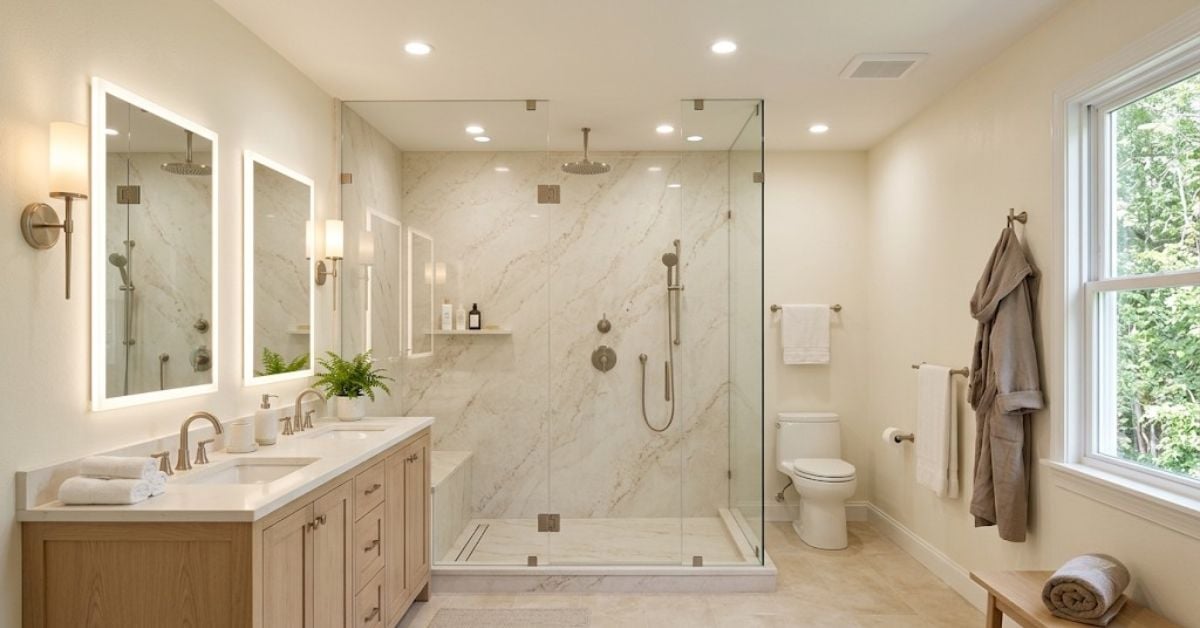
What “Warm” Actually Means in a 2026 Bathroom
Warm does not mean beige walls, brown tile, and oil-rubbed bronze everywhere. The current direction is subtler. Warmth comes from undertone and material: a white with a small amount of cream, a pale stone surface with taupe movement, a white oak vanity, brushed or champagne-toned hardware, or a soft clay accent that keeps the room from feeling sterile.
The best way to think about the change is “natural neutral” rather than “beige revival.” A successful warm bathroom can still look crisp and modern. The difference is that the room has texture and visual temperature. This is why warm woods, realistic stone patterns, matte surfaces, and carefully coordinated metals are showing up together so often in current bathroom design.
Five Color Directions Replacing Flat Cool Gray
1. Creamy White and Soft Ivory
Bright blue-white can make a bathroom feel clean but also clinical, especially under cool LED lighting. Warmer whites and soft ivories keep the same light-reflective benefit while pairing more naturally with wood cabinetry, stone veining, brushed metals, and skin tones.
2. Mushroom, Putty, and Warm Taupe
These colors sit between gray and beige, which makes them especially useful for homeowners who already have gray flooring or cool-toned stone they do not want to replace. A warm taupe wall or vanity can bridge the old cool palette and a newer warm direction without creating a visible clash.
3. Sand, Clay, and Muted Terracotta
Earth-derived colors work best as accents rather than as the entire room. A muted clay towel, painted vanity, niche back, or small decorative surface gives a bathroom personality without making it feel theme-driven.
4. Muted Green
Sage, olive-gray, and softened eucalyptus tones work because they behave almost like neutrals while adding a nature connection. They pair especially well with white oak, warm stone, brushed nickel, matte black, or restrained brass accents.
5. Warm Charcoal Instead of Blue-Gray
Dark bathrooms are not disappearing. The shift is from icy graphite toward warmer charcoal and brown-black tones. Used on a vanity, mirror frame, or hardware, these deeper colors give contrast without pulling the whole room back toward a cold gray scheme.
The Material Shift Matters More Than the Paint Color
- Natural-looking stone surfaces. Carolina Creek’s stone shower systems are available in a wide range of colors and textures, which means the shower can carry the main warm-neutral direction without relying on grout-heavy tile patterns.
- Wood-tone vanities. White oak, medium oak, walnut, and similar natural wood finishes add warmth immediately and pair well with both light and dark stone.
- Matte and honed-looking finishes. High-gloss cool surfaces bounce light hard. Softer finishes create depth and make large bathroom surfaces feel more residential and less showroom-like.
- Clear frameless glass. Instead of adding another visible frame color around the shower, frameless glass keeps attention on the stone and lets the palette read continuously across the room.
- Intentional mixed metals. A warm decorative finish can work with a cooler utility finish when the grouping is deliberate. The goal is contrast with structure, not random mixing.
The undertone test: Put the stone sample, vanity finish, flooring sample, and metal finish together under the bathroom’s actual lighting before ordering anything. A surface that looks creamy in a showroom can read yellow at home; a “warm gray” can turn violet next to the wrong wood. Samples viewed together prevent most expensive color mistakes.
Cool-Gray Bathroom vs 2026 Warm-Natural Bathroom — Side by Side
| Element | Older Cool-Gray Default | 2026 Warm-Natural Direction |
|---|---|---|
| Wall Color | Cool gray / blue-white | Cream, putty, mushroom, warm white |
| Vanity | White or cool-painted cabinet | Natural wood or warm painted neutral |
| Shower Surface | Small cool-gray tile | Large stone-look or composite stone panels |
| Hardware | One cool finish everywhere | One dominant finish + one intentional accent |
| Visual Effect | Crisp, uniform, sometimes sterile | Layered, natural, softer and more residential |
| Best Use | Minimalist or intentionally cool scheme | Transitional, contemporary, spa-like and luxury schemes |
How to Warm Up an Existing Gray Bathroom Without Starting Over
Where Carolina Creek’s material system fits: Groutless composite stone works especially well with the 2026 palette shift because the shower can be selected as one continuous color-and-veining field rather than assembled from hundreds of individual tiles. See our composite stone shower wall guide and custom shower installation options for the material and design approach.
FAQ — 2026 Bathroom Colors and Materials
Is gray completely out for bathrooms in 2026?
No. Cool, flat gray used across every surface is losing momentum, but gray still works when it is balanced with warmer wood, stone, textiles, or metal finishes. Warm gray and greige can be especially useful transition colors.
What is the safest warm palette if I do not want the bathroom to look trendy?
Start with warm white, natural wood, and a stone surface that mixes cream, taupe, and restrained gray. Those materials are easier to live with long-term than a strong fashion color applied to large permanent surfaces.
Should shower glass hardware match every faucet and cabinet pull?
Not necessarily. A deliberate two-finish plan can look more designed than forcing every item to match. Keep the wet-zone hardware consistent, then use a second finish in the vanity or decorative zone if the overall palette supports it.
Can composite stone work in a warm bathroom palette?
Yes. Carolina Creek uses natural and composite stone shower systems available in a broad range of colors and textures. Warm creams, taupes, stone whites, and patterns with natural movement can pair with wood cabinetry and warmer hardware without adding grout maintenance.
How do I choose colors accurately before installation?
Compare physical samples in the actual bathroom, at different times of day, next to the flooring, vanity finish, countertop, and metal finishes that will remain. Carolina Creek can walk homeowners through material and finish choices during an in-home consultation.
Related Bathroom Design & Remodeling Resources
- Mixed Metal Finishes in the Bathroom — how to combine finishes without making the room look mismatched.
- What Is Composite Stone? — a plain-English guide to groutless shower wall materials.
- Premium Stone Shower Design Lake Norman — custom stone shower installations and design options.
- Custom Stone Shower Installation Davidson, NC — groutless stone shower design for Davidson homes.
- Shower Installation in Mooresville & Greater Charlotte — stone walls, built-in seating, niches, frameless glass, and fixtures.
Build a Bathroom Palette Around Real Materials
Carolina Creek Tub & Shower helps homeowners compare stone, glass, fixtures, layouts, and finish combinations in the context of the actual room — with owner-led guidance, no-pressure consultations, and a lifetime warranty on installations.