Get a Free Comfort Height Toilet Today
What Is Composite Stone? A Plain-English Guide to Shower Wall Materials
Non-Porous
No sealing, no mold, no grout maintenance
89%
Homeowners now want fewer or no grout lines (NKBA 2026)
25+ Yrs
Typical service life of composite stone panels
Lifetime
Warranty on every Carolina Creek install
If you have been researching bathroom remodels in 2026, you have almost certainly seen the phrase “composite stone” — or one of its close cousins, “engineered stone,” “cultured stone,” “stone panel,” or “solid surface stone.” What none of these product descriptions explains clearly is what the material actually is, what it is made of, how it compares to alternatives like tile or acrylic, and whether it makes sense for your bathroom.
This guide is the plain-English explainer. Read it once and you will understand exactly what a composite stone shower panel is, why 89% of homeowners in the NKBA 2026 Bath Trends Report now prefer fewer or no grout lines, how composite stone stacks up against ceramic tile and acrylic, and where composite stone is genuinely the right choice — and where it is not.
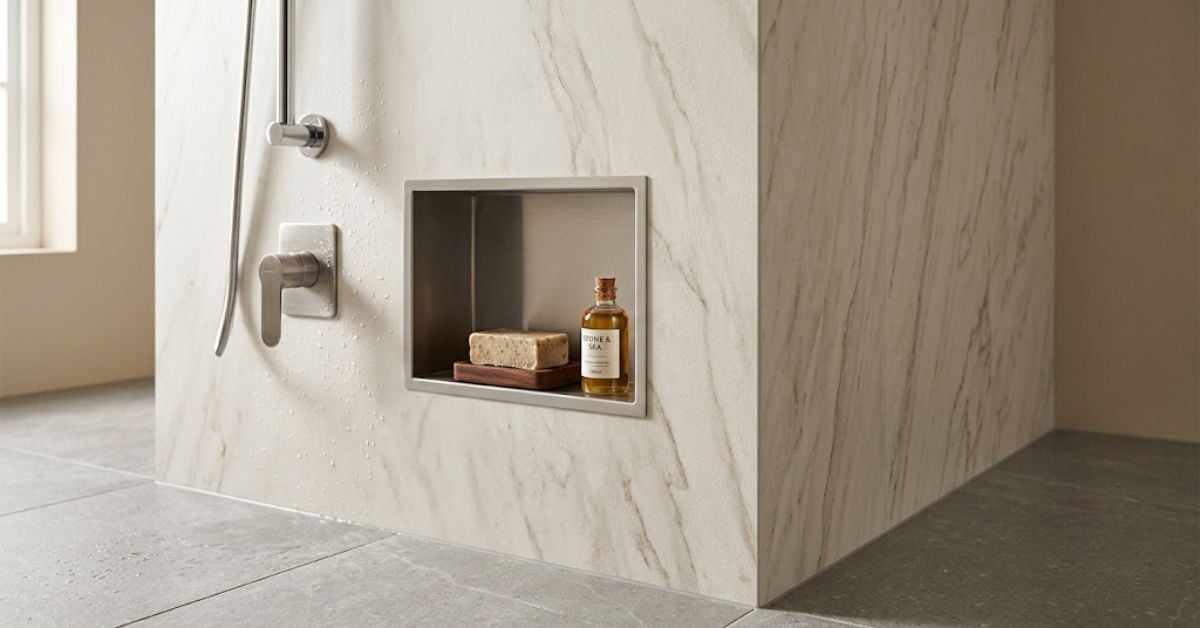
What Composite Stone Actually Is
Composite stone is a manufactured material made by combining natural stone particles — typically crushed marble, quartz, or granite — with polymer resins that bind the particles into a solid, non-porous slab. The stone content varies by manufacturer and product line, but high-quality composite stone shower panels are typically 60 to 80 percent natural stone by weight, with the balance being resin binder plus pigments that produce the veining and color.
The result is a material that looks like natural stone (because it substantially is natural stone), performs better than natural stone in wet environments (because the resin binder makes it non-porous), and installs as large-format panels instead of small tile pieces (because it is manufactured to specification rather than quarried and cut). The Onyx Collection is the most established manufacturer used by installers across North Carolina, and the material is often referred to by that brand name.
What Composite Stone Is Not
Composite stone is not acrylic. Acrylic shower surrounds are thermoformed plastic sheets — they are lightweight, hollow-feeling, and photograph as plastic in bright light. Composite stone is a heavy, solid material that feels and photographs like stone because it is made of stone.
Composite stone is also not cultured marble. Cultured marble uses a similar resin-and-stone approach but is typically a lower stone content (30 to 50 percent), thinner cross-section, and gloss-finished. It has been used for decades in vanity tops and older shower surrounds and is not the current market standard for premium bathroom installations.
And composite stone is not natural stone slab. Natural stone (marble, granite, travertine) quarried from the earth and cut into slabs is beautiful but has different practical considerations — it is porous and requires periodic sealing, it can crack under stress, and matching veining across multiple pieces is difficult. Composite stone offers the aesthetic without those specific challenges.
Why This Material Category Has Taken Over the 2026 Market
Every credible source of 2026 bathroom trend data points the same direction. NKBA’s 2026 Bath Trends Report shows 89 percent of homeowners now prefer fewer or no grout lines. Houzz’s 2025 US Bathroom Trends Study shows large-format materials replacing small tile in 68 percent of upgraded showers. Fixr’s 2026 report identifies groutless surfaces as one of the top-three fastest-rising material categories. This is not a fashion cycle. This is a mature market conclusion.
The Grout Problem
In a typical ceramic tile shower, roughly 3 to 6 percent of the wall surface is grout — the porous material that fills the seams between tiles. Grout absorbs water, harbors soap scum, hosts mold and mildew growth, discolors over time, and requires periodic sealing to slow (not stop) these problems. In North Carolina’s humid climate, grout maintenance is not optional; it is a recurring homeowner obligation with a real time and cost burden.
The most-cited material regret in bathroom renovation discussions online is grout — homeowners describe scrubbing grout as “the bane of my existence” and wish they had chosen a different material during their remodel. Composite stone eliminates the problem entirely: no grout means no mold, no discoloration, no sealing, and no scrubbing.
The Seam Problem
Composite stone shower panels are large-format — typically 60 by 96 inches or larger — with each wall of a shower using one to three panels rather than hundreds of tiles. Seams between panels are minimal, precisely fitted, and sealed with color-matched sanitary silicone that lasts 15 to 20 years. The visual effect is a single continuous stone surface, which reads as luxury design and dramatically simplifies cleaning.
Composite Stone vs the Alternatives — Side by Side
| Attribute | Composite Stone | Ceramic Tile | Acrylic Surround |
|---|---|---|---|
| Material composition | 60–80% natural stone + resin binder | Fired ceramic tiles + grout | Thermoformed plastic sheet |
| Surface | Non-porous, no sealing needed | Tile is non-porous; grout is porous | Non-porous plastic surface |
| Grout lines | None — large-format panels | Extensive — 3–6% of wall surface | None |
| Cleaning burden | Wipe with soap and water | Grout scrubbing + periodic sealing | Easy but shows soap scum on gloss finish |
| Mold and mildew resistance | Excellent | Grout hosts mold in humid climates | Good, but caulk seams can harbor mold |
| Visual appearance | Realistic natural stone look | Wide design range; small-tile look | Reads as plastic in bright light |
| Design flexibility | Panels + coordinated shelves, benches, and niches | Very high — any pattern, any size | Limited — product-driven |
| Installed cost range | $5K–$10K per shower | $4K–$12K per shower | $3K–$7K per shower |
| Typical service life | 25+ years | 15–25 years (grout fails first) | 10–20 years |
| Installation time | 1–2 days | 3–5 days | 1 day |
The core tradeoff: Ceramic tile offers the widest design freedom (any pattern, any size, any shape) at the highest maintenance cost. Composite stone offers a strong subset of designs (any color palette, any panel configuration, integrated niches and benches) with dramatically lower maintenance. Acrylic offers the lowest upfront cost with the shortest service life and the weakest premium appearance. For most 2026 remodels, composite stone hits the practical sweet spot.
When to Choose Composite Stone — and When Something Else Fits Better
Composite Stone Is the Right Choice When…
- You want a premium stone appearance without the maintenance burden of grout.
- You are remodeling a primary or master bathroom you use daily and want the finished result to feel luxurious for 20+ years.
- You live in a humid climate (like North Carolina) where mold and mildew on tile grout is a recurring problem.
- You are designing for aging in place and want to minimize future maintenance obligations.
- You want integrated features (bench seats, recessed niches, shelves) that read as intentional design.
- You are on a moderate to premium remodel budget ($15K to $40K+ project range).
Ceramic Tile Might Fit Better When…
- You have a specific design pattern in mind (herringbone, mosaic accent walls, hand-painted tile) that requires small-tile flexibility.
- You want a distinctly non-stone aesthetic — subway tile, encaustic, painted patterns.
- You are willing to accept the ongoing grout maintenance in exchange for the design freedom.
- Note: modern large-format porcelain tile with tight grout lines is a reasonable middle-ground compromise.
Acrylic Might Fit When…
- The bathroom is a rarely-used secondary or guest space where basic function matters more than premium appearance.
- Budget constraints are severe and the alternative is doing nothing at all.
- You need installation completed in a single day and are willing to accept the shorter service life and lower premium appearance.
How Composite Stone Actually Gets Installed
The installation process matters because composite stone is only as good as its installation. A poorly installed premium panel system underperforms a well-installed tile shower. Here is what a proper composite stone shower install involves:
1
Demolition and Substrate Prep
Existing shower removed to the studs. Substrate inspected for water damage, mold, or framing issues. Wall blocking added for grab bars, shelves, niches, and any hardware to be mounted on the panels. Subfloor corrected as needed.
2
Waterproofing
Waterproof membrane installed on the substrate behind where the panels will sit, extending well beyond the shower footprint for curbless entries. This layer is what actually keeps water out of the wall — the panels are the visible skin over it.
3
Panel Templating and Cutting
Precise measurements taken of each wall, plus locations for the shower valve, showerhead, niche, and any wall-mounted hardware. Panels custom-cut to fit — either on site or ordered pre-cut from the manufacturer. This is where installer experience shows most clearly.
4
Panel Installation
Panels installed with structural adhesive and mechanical fasteners as specified by the manufacturer. Seams between panels precisely aligned. Color-matched sanitary silicone applied at seams, corners, and around fixtures. Wall panels typically installed before the shower base is set.
5
Finishing Details
Shower fixtures mounted, glass enclosure installed and sealed, grab bars secured into the pre-installed blocking, integrated bench (if included) fitted and sealed. Silicone cure time observed before first use, typically 24 to 48 hours.
FAQ — Composite Stone Shower Walls
Is composite stone the same as quartz?
Similar family, different product. Both are engineered from natural stone particles and resin binder. Quartz (the countertop material) is primarily quartz aggregate with a very high stone content, engineered for kitchen and bathroom countertops. Composite stone shower panels use crushed marble or granite aggregate, engineered specifically for large-format wall panels. Same manufacturing principle, different formulations optimized for different uses.
Does composite stone yellow or discolor over time?
Modern composite stone with UV-stable resins does not yellow under normal indoor bathroom conditions. Older cultured marble products from the 1970s and 1980s sometimes yellowed after decades of use — that is a different generation of technology. Current-generation composite stone panels typically look the same at year 20 as they did at year 1, provided they are not exposed to direct sunlight for hours daily.
Can composite stone be repaired if damaged?
Yes, in most cases. Small chips can be filled with a color-matched resin repair kit provided by the manufacturer. Deeper damage in an isolated area of one panel can sometimes be sanded and refinished. Catastrophic damage may require replacing a full panel — which is a professional job but doable in a day. Compare this with tile, where damage to a single tile usually requires removing surrounding grout and matching the original tile from a discontinued run.
How do I clean composite stone shower panels?
A soft cloth with warm soapy water or a mild bathroom cleaner is sufficient for weekly cleaning. Because the surface is non-porous, soap scum and mineral deposits do not bond deeply and wipe away easily. Avoid abrasive scrubbing pads, harsh chemicals like bleach or ammonia in high concentrations, and acidic cleaners like undiluted vinegar. Most manufacturers include specific cleaning recommendations with the product warranty.
Where can I see composite stone in person before deciding?
A qualified installer brings full-size samples to an in-home consultation — the material’s weight, texture, and depth are hard to appreciate from a small chip or a website photo. Carolina Creek Tub & Shower brings the full sample range to consultations across Lake Norman stone shower projects, Davidson installations, Matthews stone shower work, and every other city we serve — so you can hold the material, compare colors and veining under your own lighting, and choose confidently.
Composite Stone Shower Services Across North Carolina
- Premium Stone Shower Design Lake Norman — composite stone shower installations across the Lake Norman region.
- Custom Stone Shower Installation Davidson, NC — Davidson composite stone shower design.
- Custom Stone Shower Cornelius, NC — Cornelius composite stone shower installations.
- Stone Shower Installation Matthews, NC — Matthews composite stone shower design and installation.
- Custom Shower Installation Huntersville — Huntersville composite stone shower work.
- Custom Shower Design Mint Hill — Mint Hill composite stone shower installations.
See Composite Stone in Person at a Free Consultation
Full-size samples brought to your home, honest guidance on which material fits your specific bathroom and budget, itemized written quotes, and a lifetime warranty on every installation.