Get a Free Comfort Height Toilet Today
Mixed Metal Finishes in the Bathroom – When It Looks Designed and When It Looks Like a Mistake
2 Metals
The maximum for most successful mixes
70/30
Dominant-to-accent finish ratio that works
4 Zones
To think about when planning mixed metals
Lifetime
Warranty on every Carolina Creek install
For thirty years, the guiding rule of bathroom hardware was simple — pick one finish and use it everywhere. Faucets, cabinet pulls, towel bars, showerheads, robe hooks, and grab bars all matched. That rule kept builder-grade bathrooms from looking chaotic and gave homeowners a safe default. It also, over time, produced a lot of bathrooms that looked exactly like every other bathroom in the same price range.
In 2026, the design world has moved past the single-finish rule. Intentional mixed metals — deliberately combining two finishes to define zones, add contrast, and produce visual richness — is now standard practice in premium bathroom design. But the emphasis is on intentional. Mixed metals done well read as designed. Mixed metals done poorly read as builder-grade or worse — like the previous owner replaced fixtures piecemeal and gave up on coordinating them. This guide explains the difference.
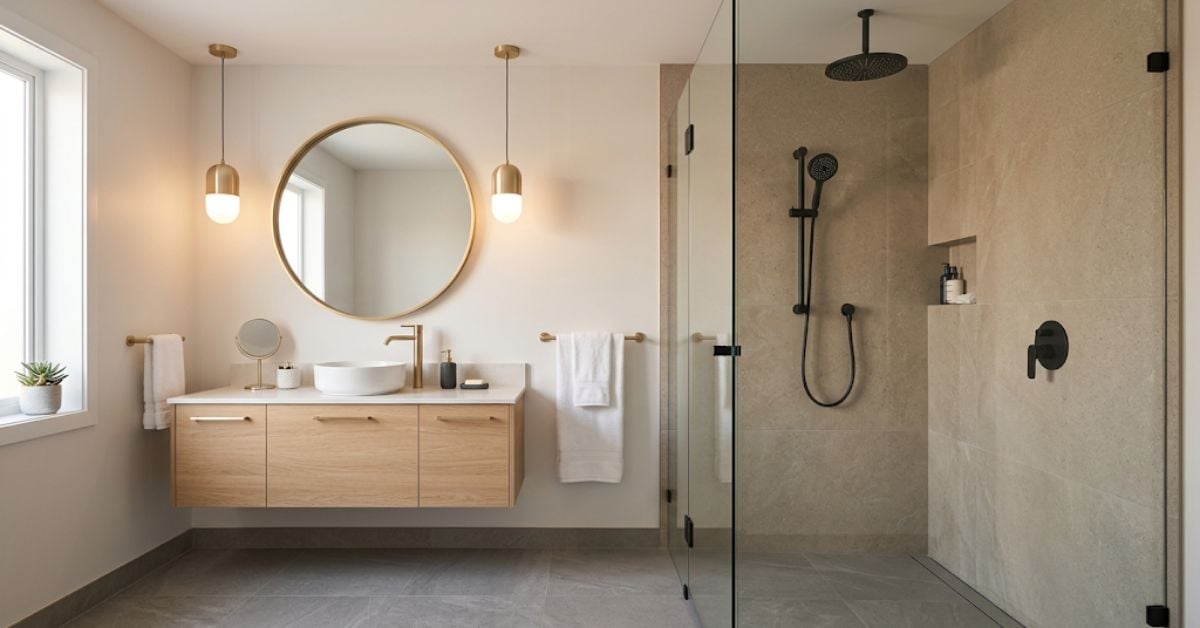
Why the “Match Everything” Rule Changed
The single-finish rule made sense when hardware options were limited and homeowners had few tools to signal intentional design. Today’s hardware market offers dozens of finishes in coordinated families across every major manufacturer — brushed nickel, polished chrome, matte black, oil-rubbed bronze, brushed gold, champagne bronze, polished brass, and more. Using only one finish across a bathroom now feels like eating at a five-star restaurant and ordering plain toast for every course.
Three converging factors made intentional mixed metals mainstream in 2026:
- Coordinated collections across finishes. Major manufacturers now design fixture families where each shape is available in multiple finishes — meaning a matte black faucet from the same collection as a brushed gold cabinet pull will share the same design language even in different colors. The visual link between them is design intent, not finish match.
- Warm palettes replacing cool grays. Bathrooms with warm neutral wall colors and natural wood accents look richer with two metals (typically a warm and a cool) than with a single finish across everything. The 2026 palette shift and the mixed metal trend reinforce each other.
- Design-forward buyer expectations. Homebuyers in premium markets — Lake Norman, Ballantyne, Davidson — increasingly read single-finish bathrooms as either builder-grade or dated. Mixed metals done deliberately is the current signal of professional design attention.
The Line Between “Designed” and “Mistake”
The difference is entirely about intent and consistency. Mixed metals read as designed when the pattern is obvious enough that a viewer can identify the logic within the first few seconds of entering the room. They read as a mistake when finishes appear scattered — chrome here, brass there, bronze somewhere else — with no coherent grouping.
Reads as Designed
- Exactly two finishes across the whole room (not three, not four).
- Each finish groups into a recognizable zone or fixture category.
- One finish clearly dominates (70%) and the other is accent (30%).
- The two finishes have complementary undertones (both warm, both cool, or one clear warm and one clear cool).
- Fixtures within a family (e.g. all showerhead + valve + handheld) share the same finish.
Reads as a Mistake
- Three or more finishes appearing across the room.
- Finishes scattered without clear grouping — chrome faucet, nickel cabinet pull, bronze towel bar.
- Two finishes used in roughly equal amounts (50/50) with no clear dominant.
- Finishes with clashing undertones (warm brass next to cool chrome without a clear zone division).
- Shower faucet in one finish, showerhead in another — breaking the fixture-family rule.
The Four Zones to Think About
The easiest way to plan intentional mixed metals is to divide the bathroom into four hardware zones and assign a finish to each zone rather than picking finishes fixture by fixture. Every fixture within a zone gets the same finish; the finishes between zones can differ or match depending on your design direction.
Zone 1: Wet Zone (Shower and Tub)
All hardware inside and immediately around the shower — showerhead, handheld, valve control, drain grate, glass door hardware, integrated shower niche, and grab bars — should share the same finish. Same rule for a freestanding tub — filler, drain, and any adjacent hardware match. This is the strongest visual grouping in the room and should be treated as one finish decision.
Zone 2: Toilet Zone
The toilet handle, side grab bar, toilet paper holder, and any decorative hardware in the toilet area. Typically matches the wet zone in a two-finish scheme — grouping all “utility” hardware under one finish makes the design pattern easier to read.
Zone 3: Vanity Zone
The vanity faucet, cabinet pulls, drawer knobs, and any hardware on the mirror frame or attached lighting fixtures. This zone often carries the accent finish in a mixed-metal scheme — the vanity is the visual centerpiece of most bathrooms and can accept a warmer or more decorative finish than the wet-zone hardware.
Zone 4: Decorative Zone
Towel bars, robe hooks, light fixture bodies, and any decorative accessories. This zone typically follows the vanity zone finish in a two-finish scheme, since these elements sit visually adjacent to the vanity area and read as part of the same design group.
The two-finish framework: Assign the wet zone and toilet zone one finish (usually the more restrained option — brushed nickel, matte black, oil-rubbed bronze). Assign the vanity zone and decorative zone the second finish (often the warmer or more decorative option — brushed gold, champagne bronze, polished brass). This produces a room where the design logic is immediately readable and the two finishes reinforce rather than compete.
Combinations That Work — and Combinations That Don’t
Successful 2026 Combinations
| Wet/Utility Zone | Vanity/Decorative Zone | Design Character |
|---|---|---|
| Matte Black | Brushed Gold | The dominant 2026 combination — strong contrast, contemporary, works in transitional and modern bathrooms. |
| Brushed Nickel | Champagne Bronze | Subtle contrast, warm and welcoming, works in transitional and traditional bathrooms. |
| Oil-Rubbed Bronze | Brushed Gold | Both warm tones, rich and layered, works in craftsman, farmhouse, and traditional bathrooms. |
| Matte Black | Polished Brass | Bold contrast, dramatic, works in modern and Art Deco-inspired bathrooms. |
| Brushed Nickel | Matte Black | Cool-only mix, contemporary and clean, works in minimalist and modern bathrooms. |
Combinations That Rarely Work
- Polished chrome + brushed nickel. The finishes are too similar to read as intentional contrast, but different enough to read as accidental mismatch. Pick one.
- Bright chrome + warm brass. The undertone clash is too severe — chrome reads cool and industrial, warm brass reads warm and traditional. They fight rather than complement.
- Three or more finishes. Any bathroom with three or more finishes in significant use reads as chaotic regardless of individual finish quality. Two-finish maximum for almost every residential bathroom.
- Two finishes used in roughly equal amounts. Without a dominant finish, the eye reads competition rather than accent. Stick to a 70/30 or 80/20 ratio.
How to Execute Mixed Metals in Your Bathroom
1
Pick your two finishes first.
Decide the combination before picking any specific fixtures. Buy sample tiles or physical samples of each finish and view them together in your actual bathroom lighting before committing.
2
Assign each zone a finish.
Wet zone + toilet zone = Finish A. Vanity zone + decorative zone = Finish B. Or reverse the pairing if the design calls for it. Write it down so every purchasing decision follows the plan.
3
Source from coordinated fixture families where possible.
Major manufacturers offer the same fixture shapes in multiple finishes. Using the same collection across both finishes reinforces the design intent — the shapes tie the room together even when the colors differ.
4
Keep grab bars in the same finish as their zone.
Grab bars in the shower match wet-zone finish; grab bars beside the toilet match toilet-zone finish. This preserves the two-finish framework and keeps accessibility hardware from reading as institutional.
5
Confirm the plan with a physical mock-up.
Before final purchase, arrange sample hardware pieces together on a flat surface in the actual bathroom lighting. Photograph the arrangement. Live with the photo for a week. If the combination still reads as intentional design after seven days of scrutiny, buy the fixtures.
FAQ — Mixed Metal Finishes in the Bathroom
Is mixed metals a fad or a lasting design direction?
Lasting. The 2026 NKBA and Houzz trend reports both show intentional mixed metals as an established practice rather than a rising fad — designers have been executing them across premium projects for several years, and the residential market has now caught up. Historic reference: mixed metals were the norm in Art Deco, Victorian, and Craftsman-era bathrooms. The single-finish rule was itself a mid-20th-century simplification. What we call “intentional mixed metals” today is closer to the historical residential design tradition than the single-finish rule was.
Can I add mixed metals to an existing bathroom without a full remodel?
Yes, if you replace hardware in coordinated groups. The wrong way: swap out one fixture at a time as they wear out, ending up with three different finishes over five years. The right way: identify your two-finish scheme, then replace all wet-zone hardware in one weekend and all vanity-zone hardware in another. The zone-consistency principle applies whether you are remodeling or refreshing.
What if my faucet manufacturer doesn’t make the finish combination I want?
Cross-manufacturer mixing is fine as long as the fixture shapes are similar enough to read as coordinated. Two manufacturers with clean modern lines will look intentional together in different finishes. A traditional decorative faucet from one brand paired with a minimalist modern cabinet pull from another will look chaotic — the shape mismatch reads as accidental. Match shape sensibility across brands even when finishes differ.
Do mixed metals affect resale value?
Positively when done well. Designer buyers actively look for intentional mixed metals as a signal of professional design attention. Neutrally when done timidly (subtle two-finish combinations that read as coordinated regardless of the buyer’s sophistication). Negatively only when executed poorly enough to read as accidental mismatch. In premium markets, the design signal outweighs the risk.
How do I know if my finish combination is working?
A qualified installer or designer can review the finish plan before purchase and flag any combinations at risk of reading as unintentional. Carolina Creek Tub & Shower includes hardware finish planning as part of every remodel consultation across Lake Norman luxury bathroom projects, Davidson master bath work, and every other city in our NC service area — with sample hardware brought to the home so combinations can be viewed under actual lighting before committing.
Related Master Bathroom Design Services
- Luxury Bathroom Remodeling Lake Norman — full master bathroom design and hardware planning.
- Luxury Master Bathroom Remodeling Davidson, NC — Davidson master bathroom projects.
- Luxury Master Bath Remodeling Cornelius, NC — Cornelius master bath design.
- Master Bathroom Remodeling Huntersville, NC — Huntersville master bathroom services.
- Master Bathroom Remodeling Matthews, NC — Matthews master bathroom design.
- Luxury Bathroom Remodeling Mint Hill — Mint Hill luxury bathroom design.
Plan Your Mixed Metal Bathroom With a Designer
Owner-led consultations, hardware sample review under your bathroom’s actual lighting, coordinated finish planning across all four zones, and a lifetime warranty on every installation.