Get a Free Comfort Height Toilet Today
Frameless vs Semi-Frameless vs Framed Shower Glass – What Each Tier Actually Buys You
3 Tiers
Framed, semi-frameless, and frameless
Most Open
Frameless has the least visible metal
Custom Fit
Measurements and hardware drive the result
Lifetime
Warranty on Carolina Creek installations
Shower glass is one of the last major choices in a bathroom remodel, but it changes how the entire finished room reads. The same stone shower can look builder-basic with a heavy metal frame, cleaner with a semi-frameless system, or significantly more open with a frameless enclosure. The difference is not just appearance. Each tier uses a different amount of supporting metal, creates a different cleaning profile, allows different door and panel configurations, and puts different demands on measurement and installation accuracy.
Carolina Creek Tub & Shower offers frameless glass as a customization option on its shower projects and helps homeowners compare shower-door configurations through its HMI shower-door resources. This guide explains what framed, semi-frameless, and frameless actually mean, what you gain as you move up each tier, when the premium is visually worthwhile, and when a simpler enclosure is the smarter fit.
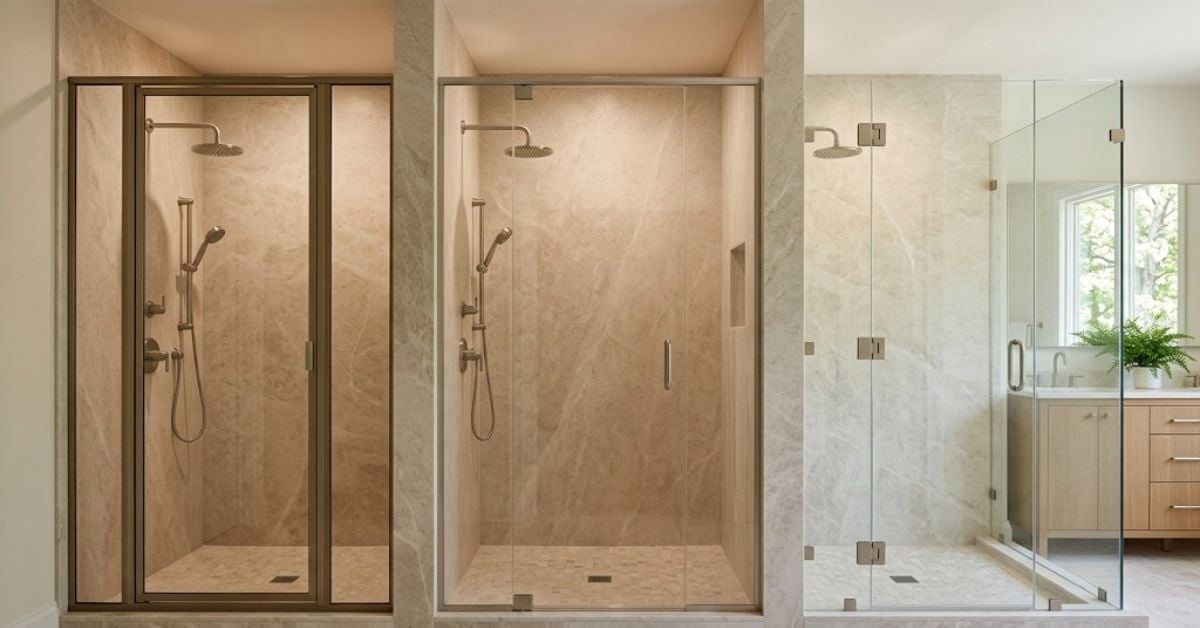
The Difference Is How Much Metal Holds the Glass
Framed Shower Glass
A framed enclosure uses metal channels around most or all outer edges of the glass. The frame provides structural support, helps control water at the perimeter, and allows the system to use lighter glass than many frameless designs. Visually, the frame becomes part of the shower. That can work well in a traditional bathroom or a budget-focused secondary bath, but it also breaks up the view of premium stone walls.
Semi-Frameless Shower Glass
Semi-frameless systems reduce the amount of visible metal. The fixed panels may still sit in perimeter channels or a top rail, while the door itself often has cleaner exposed glass edges. The result is a middle-ground look: less visual weight than a full frame, with more structural metal than a true frameless enclosure.
Frameless Shower Glass
Frameless glass minimizes channels and perimeter framing. Panels are supported by precision hardware such as hinges, clips, brackets, and handles. Because there is less metal hiding wall and floor tolerances, measurements and substrate preparation matter more. The reward is the cleanest sightline: the stone walls, niche, fixtures, and overall shower design remain visible instead of being visually boxed in.
What You Actually Buy as You Move Up Each Tier
1. Cleaner Sightlines
The most obvious upgrade is visual. Heavy frame members interrupt the view around the shower perimeter. Semi-frameless reduces that interruption. Frameless removes most of it. If you are paying for premium stone panels, built-in niches, a bench, or coordinated hardware, frameless glass allows those choices to remain visible from across the room.
2. Easier Surface Access for Cleaning
Every additional metal channel creates edges, corners, and transitions where soap residue and mineral deposits can collect. Frameless glass does not eliminate cleaning — glass still needs regular wiping — but it reduces the number of frame tracks and channel edges that need detailed scrubbing.
3. More Custom Configuration Freedom
Custom frameless systems are well suited to showers with fixed panels, corner returns, benches, curbless entries, and unusual dimensions because the glass can be fabricated around the actual finished opening. That flexibility matters when the shower itself is custom rather than a standard kit.
4. Higher Demand for Accurate Installation
A full frame can hide small variations in a wall or opening. Frameless glass cannot hide nearly as much. Walls need to be prepared correctly, finished dimensions need to be accurate, blocking for hardware must be where it belongs, and final glass measurements need to be taken after the shower surfaces are complete.
5. More Visible Hardware Quality
When there is less metal overall, the hardware that remains matters more. Hinges, handles, clips, sliders, and finish quality become visible design elements. That is why comparing hardware feel, operation, and finish options is part of choosing a shower-door system — not an afterthought.
The measurement rule: Final shower glass should be planned early but measured late. The door swing, hardware location, curb or base, bench, and plumbing all need to be considered before construction; the final glass dimensions should reflect the finished shower surfaces, not rough framing dimensions.
Framed vs Semi-Frameless vs Frameless — Side by Side
| Factor | Framed | Semi-Frameless | Frameless |
|---|---|---|---|
| Visible Metal | Most | Moderate | Least |
| Visual Openness | Lowest | Medium | Highest |
| Cleaning Detail | More tracks/channels | Fewer channels | Fewest frame edges |
| Tolerance for Wall Variation | Most forgiving | Moderate | Least forgiving |
| Custom Look | Basic / traditional | Upgraded middle ground | Premium / minimal |
| Best Fit | Budget-focused or traditional bath | Value-conscious visual upgrade | Custom stone, master bath, open design |
When Frameless Glass Is Worth the Upgrade
The Glass Should Be Chosen With the Shower — Not After It
A common remodeling mistake is to finish the shower first and treat the glass as a separate purchase. The better approach is to plan the glass configuration while the shower layout is still being designed. Door swing affects towel-bar and toilet clearance. Hardware needs structural support. Curbless entries change water-containment strategy. Benches and pony walls affect panel dimensions. Fixture placement affects where the door can open without collision.
Carolina Creek’s shower installation service includes customizable choices such as niches, built-in seating, frameless glass, and high-end fixtures, which is exactly why these decisions should be coordinated as one system rather than made independently.
The practical Carolina Creek fit: Frameless glass is especially effective when paired with premium stone shower installations because it keeps the groutless wall system visually open. Homeowners can also review finish, hardware, fit, and configuration options through the HMI shower-door guide.
FAQ — Shower Glass Tiers
Does frameless glass mean there is no metal at all?
No. Frameless means the enclosure does not rely on a full perimeter frame. Hinges, clips, brackets, handles, and other hardware are still required, but they are visually minimized compared with a fully framed system.
Is frameless glass easier to clean?
It can be easier because there are fewer perimeter channels and tracks to scrub. The glass itself still needs regular cleaning, especially in homes with hard water, but the enclosure has fewer detailed metal edges where residue can collect.
Is semi-frameless the best value?
It can be a useful middle ground when a homeowner wants less visible metal without prioritizing the fully open look of frameless glass. The best choice depends on the shower layout, the room’s design level, the hardware options, and the finished opening.
Does Carolina Creek install frameless shower glass?
Yes. Frameless glass is listed as a customization option for Carolina Creek shower installations and stone shower projects, alongside built-in seating, niches, and premium fixtures.
Can I see shower-door options before I decide?
Yes. Carolina Creek provides access to HMI shower-door product resources and can help compare finishes, configurations, measurements, and hardware choices during the design process.
Related Shower & Glass Resources
- HMI Shower Doors — compare glass clarity, finishes, hardware, fit, and configuration options.
- Custom Shower Installation — stone walls, niches, built-in seating, frameless glass, and premium fixtures.
- Premium Stone Shower Design Lake Norman — custom stone showers with optional frameless glass.
- Custom Stone Shower Installation Davidson, NC — stone shower layouts and glass enclosure options.
- Composite Stone Shower Wall Guide — understand the wall material that frameless glass is often designed to showcase.
Choose the Glass Around the Shower You Are Actually Building
Carolina Creek Tub & Shower can help compare shower-door finishes, configurations, measurements, and frameless options as part of a coordinated stone shower or bathroom remodel — with owner-led guidance and a lifetime warranty on installations.