Get a Free Comfort Height Toilet Today
Shower Renovation vs Shower Replacement – Which One Does Your Bathroom Actually Need?
$1.5K–$5K
Typical renovation range
$6K–$14K
Typical replacement range
7 Signs
You need replacement, not renovation
Lifetime
Warranty on every Carolina Creek install
The most consequential decision a homeowner makes about a tired shower is the one they usually spend the least time thinking about — whether to renovate it (repair, refinish, and update the existing shower) or replace it (demo down to the studs and build a new one from scratch). The two paths are three to five times apart in cost, deliver very different long-term results, and are wrong for each other’s situations in ways that only become clear a few years later.
This guide is the honest decision framework. It walks through what each path actually involves, the seven diagnostic signs that tell you replacement is the correct answer even if renovation is cheaper, the four situations where renovation is genuinely the right call, and the specific cost, timeline, and outcome comparisons you need before choosing.
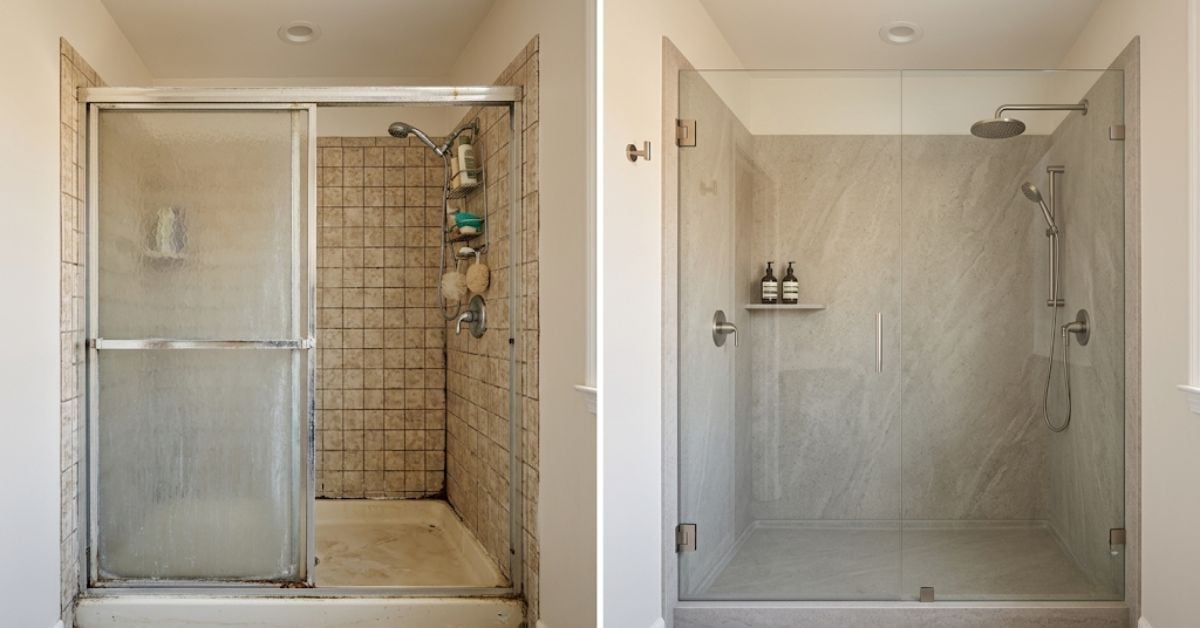
What Each Path Actually Involves
Shower Renovation — Repair and Refinish
A shower renovation keeps the underlying shower structure — the wall substrate, plumbing, drain, and basic layout — and updates the visible elements. Typical scope includes regrouting tile (or replacing damaged tiles), re-caulking seams, refinishing the shower pan, replacing fixtures and hardware, and installing a new glass door or panel. The existing wall material stays. The existing subfloor stays. The existing waterproofing stays.
Renovation is fast (1 to 3 days), relatively affordable ($1,500 to $5,000 for most projects), and cosmetically transformative. It is also fundamentally cosmetic — none of the underlying construction is touched, which means any hidden problems in the substrate, waterproofing, or plumbing continue to exist under the new finishes.
Shower Replacement — Full Demolition and Rebuild
A shower replacement demolishes the existing shower down to the studs. Walls open. Substrate is inspected for water damage, mold, or framing issues. Plumbing is inspected and updated where needed. Wall blocking is added for grab bars, shelves, and any wall-mounted hardware. Waterproof membrane is installed on the substrate. New wall material (composite stone panels, tile, or acrylic), new fixtures, new drain, new glass, and often a new shower base are installed. The result is a genuinely new shower — same footprint, but new from the studs out.
Seven Signs You Actually Need Replacement, Not Renovation
Any one of these signs pushes the decision toward replacement. Two or more, and renovation is almost certainly the wrong choice — the cosmetic upgrade will fail within a few years because the underlying problems are still there.
1
Visible mold or mildew that returns after cleaning.
Surface mold that wipes away and stays away is a cleaning issue. Mold that returns within days or weeks despite aggressive cleaning is a substrate issue — water has penetrated behind the tile or panels and mold is growing where you cannot reach. Refinishing the surface does not solve this; the mold continues in the wall cavity.
2
Soft or spongy shower floor.
A shower base that flexes under weight indicates subfloor damage — water has been reaching the wood substrate long enough to compromise the structure. This is a serious problem that gets worse quickly and cannot be addressed without opening the shower.
3
Grout that cracks, falls out, or discolors deeply within a year of repair.
Grout failing this fast after a professional repair indicates substrate movement — the wall behind the tile is flexing or shifting, which the grout cannot accommodate. Regrouting again will produce the same result within another year.
4
Water staining on the ceiling below the bathroom.
If your shower is on a second floor and there is any water staining on the ceiling of the room beneath it, water is escaping the shower assembly. This is almost never a fixture leak (fixtures typically drip visibly); it is almost always a waterproofing failure. Refinishing the surface does not restore the waterproof membrane.
5
Shower is 25+ years old.
Waterproofing systems installed 25+ years ago (roll-on membranes or older-generation liners) have typically reached the end of their service life. Even without visible failures, the underlying waterproofing is aging and the wall substrate has absorbed moisture. Refinishing extends the life by only a few years; replacement is the honest path.
6
You want to change the layout, add a bench, or go curbless.
Renovation preserves the existing shower structure. Any layout change, bench addition, niche installation, or curbless conversion requires opening the walls and rebuilding the substrate — which is replacement, not renovation. If your goals include these design changes, the decision is already made.
7
You are adding accessibility features that require blocking.
Grab bars, integrated benches, and other accessibility hardware must anchor into structural wall blocking. If the existing walls do not have blocking, installing safe grab bars requires opening the walls and adding it — again, that is replacement, not renovation. Do not let a renovator install grab bars into drywall with plastic anchors; they will fail when they are needed most.
The most-cited renovation regret: Homeowner discussion threads consistently describe the same story — a renovation that looked great for the first two years, then failed in the same ways as the original shower, requiring the homeowner to spend the money a second time on the replacement they should have done the first time. If you are seeing multiple signs from the list above, the cheaper path is almost always the more expensive path in the long run.
Four Situations Where Renovation Is Genuinely the Right Call
1. The Shower Is Structurally Sound but Cosmetically Dated
A shower under 15 years old with intact grout, no signs of water damage, and no soft spots — but with dated tile color, worn fixtures, or a tired glass door — is a genuine renovation candidate. Regrout, replace fixtures, upgrade the door, and refresh the caulking. A well-executed renovation on a fundamentally sound shower can add 10 to 15 years of good service.
2. You Are Selling the Home Soon
If you are planning to list within 12 to 18 months and the shower is functionally OK but visually tired, a modest renovation ($2,000 to $4,000) can improve buyer perception without the ROI risk of a full replacement. Replacement typically returns 60 to 80 percent of its cost at sale in the NC market; renovation on a pre-sale timeline typically returns 90 to 110 percent because you are addressing perception rather than durability.
3. It Is a Rarely-Used Guest or Secondary Shower
A guest bathroom shower used a few times per month has different failure timelines than a primary shower used daily. If the guest shower is not showing signs of substrate failure and is only cosmetically tired, a modest renovation makes practical sense. Save the replacement budget for the primary bathroom where the daily-use quality matters most.
4. Budget Is Genuinely Constrained and Renovation Buys You Time
If the budget for full replacement will not be available for another 2 or 3 years and the current shower is functional but ugly, a modest renovation is a legitimate bridge. Be honest with yourself that this is a temporary measure — the underlying condition determines when the real replacement clock starts.
The Decision Framework
| Factor | Renovation | Replacement |
|---|---|---|
| Cost range | $1,500–$5,000 | $6,000–$14,000 |
| Timeline | 1–3 days | 3–7 days installation + 2–3 weeks material lead time |
| What gets addressed | Surface finishes, grout, fixtures, glass door | Everything from the studs out — substrate, waterproofing, blocking, plumbing |
| What does NOT get addressed | Hidden substrate damage, aged waterproofing, missing blocking | Nothing — everything is new |
| Layout changes possible? | No | Yes — curbless entry, benches, niches, glass upgrades |
| Accessibility features | Limited — grab bars only where existing blocking exists | Full — blocking added anywhere, curbless entry, integrated bench |
| Typical service life | 3–10 years (limited by original construction) | 20–25+ years with quality materials |
| Warranty | Typically 1–5 years on workmanship | Manufacturer + lifetime installation from established local installers |
| Resale ROI | 90–110% on pre-sale renovations | 60–80% at sale, plus faster time on market |
What to Ask During the Diagnostic Consultation
A quality contractor evaluates the shower before recommending an approach — not after. Here is what a good diagnostic consultation should include, and what to ask when it doesn’t.
- How do you check for hidden substrate damage? A good answer includes a moisture meter reading behind the tile, visual inspection where possible, and honest acknowledgment that some conditions cannot be diagnosed without opening a small section.
- Can you show me photos of similar renovations you did 5+ years ago? A contractor confident in their renovation work can show projects that have held up. A contractor who has watched their renovations fail will deflect.
- What warranty do you offer on a renovation vs a replacement? Established installers typically offer lifetime installation warranties on replacements and 1 to 5 year warranties on renovations — because the underlying condition determines what they can stand behind.
- If I do renovation now, what will replacement look like in 5–10 years? A good contractor honestly assesses the eventual replacement scope and cost so you understand the total lifetime spend. Renovation followed by replacement in 5 years is often more expensive than one replacement now.
- Do you push renovation because it is faster to schedule? Some contractors push renovation because it fills their calendar with quick jobs. An honest contractor recommends replacement when the diagnostics call for it — even though the schedule is longer and the sale is bigger.
FAQ — Shower Renovation vs Replacement
Can I convert my tub to a shower as a renovation, or is that always a replacement?
Tub-to-shower conversion is replacement territory. The floor structure of an alcove tub is fundamentally different from a shower base, the drain location is different, and waterproofing has to be extended to areas that were previously covered by the tub. Anyone offering a tub-to-shower conversion as a light renovation is skipping structural work that will cause problems within a few years.
Is a shower liner or overlay a renovation or a replacement?
Shower liners and acrylic overlays applied over existing tile or fiberglass are a form of renovation — they cover the surface without addressing the substrate underneath. They can hide cosmetic issues effectively but they do not fix water damage, aged waterproofing, or missing wall blocking. In many cases, they trap moisture between the old surface and the new liner, accelerating substrate failure.
How long does replacement disruption last?
Installation is typically 3 to 5 days for a standard tub-to-shower conversion, 5 to 7 days for a full shower replacement with a new layout. Material lead time is separate — typically 2 to 3 weeks for stone panels. Most homeowners can continue living in the home throughout, using a secondary bathroom for the days the shower is offline.
If I do renovation now and replacement later, what have I lost?
Money and time. A $3,500 renovation followed by an $11,000 replacement five years later totals $14,500 — meaningfully more than a $9,500 replacement done once. You also lose five years of the improved daily experience the replacement would have delivered, five years of easier cleaning, and the peace of mind of knowing the underlying construction is sound. Renovation before an inevitable replacement is a false economy in most cases.
Where can I get an honest diagnostic in North Carolina?
Established local installers offering both renovation and replacement services can give honest diagnostics because their business model does not depend on selling one over the other. Carolina Creek Tub & Shower provides diagnostic consultations across Lake Norman stone shower projects, Matthews installations, and every other city in our service area — including moisture readings, substrate inspection, and honest recommendations on which path fits your specific shower.
Related Shower Replacement Services
- Premium Stone Shower Design Lake Norman — Lake Norman shower replacement region-wide.
- Custom Stone Shower Installation Davidson, NC — Davidson shower replacement and design.
- Stone Shower Installation Matthews, NC — Matthews shower replacement services.
- Custom Stone Shower Cornelius, NC — Cornelius shower replacements.
- Custom Shower Installation Huntersville — Huntersville shower replacement work.
- Custom Shower Design Mint Hill — Mint Hill shower replacement services.
Get an Honest Renovation vs Replacement Diagnostic
Owner-led diagnostic consultations including moisture readings and substrate inspection. Itemized written quotes for either path. No high-pressure recommendation to spend more than the shower actually needs.