Get a Free Comfort Height Toilet Today
Heated Bathroom Floors – Worth It in North Carolina, or a Cold-Climate Luxury?
20–35°F
Typical Piedmont morning lows, Dec–Feb
$8–$25
Typical monthly operating cost, NC heating season
$2.8K–$5.5K
Typical master bath installed cost range
Lifetime
Warranty on every Carolina Creek install
“Heated floors are a Minnesota thing” is the response most North Carolina homeowners give when a remodel consultation brings up radiant floor heating. The assumption is that it only makes sense in genuinely cold climates — that Piedmont winters do not get cold enough to justify the cost, and that the whole feature is a cold-climate luxury the NC market can safely skip.
The reality is more nuanced. NC winters do get cold enough to make bare feet on tile genuinely unpleasant — Piedmont mornings routinely drop into the 20s and 30s from December through February. But the case for heated bathroom floors in North Carolina rests on more than winter comfort alone. This guide walks through what NC winters actually look like on a bathroom floor, the two heating technologies (and which one belongs in a bath-only application), the value beyond warmth that most homeowners never hear about, when heated floors are genuinely worth the investment in an NC home, when they are not, and honest cost ranges for installation and monthly operation.
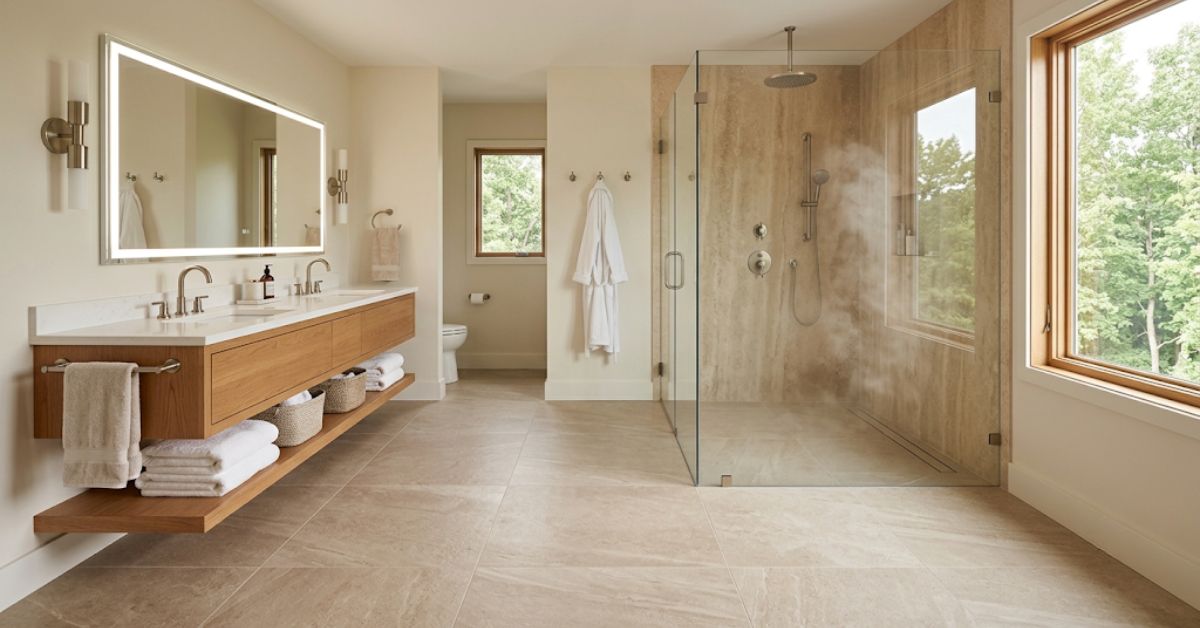
What NC Winters Actually Look Like — On a Bathroom Floor
The “NC is warm” narrative is misleading when applied to bathroom floors. Ambient bathroom air temperature during winter typically sits around 65 to 70°F because the HVAC system heats the room. Floor surface temperature is a different story — porcelain tile and stone stay meaningfully cooler than the room air because they are dense, thermally conductive materials sitting on subfloor that is often above an unconditioned crawlspace, garage, or slab.
In a typical NC home during January, a porcelain tile bathroom floor sits at 55 to 62°F even when room air is at 68°F. That temperature difference is what makes bare feet on tile feel shockingly cold every morning from December through February — the tile is drawing heat from your feet at 5 to 10 degrees below what your skin registers as neutral. In homes with bathrooms above unconditioned garages or exterior-wall bathrooms with slab foundations, tile floors can drop to 48 to 55°F in a cold snap.
This is the discomfort a heated floor eliminates. Not deep-cold-climate survival — just the daily reality of a Piedmont winter where the floor is meaningfully colder than the room and every trip to the bathroom for three months starts with a small unpleasant sensory shock.
Two Heating Technologies — and Which One Belongs in an NC Bathroom
Electric Radiant Mat (The NC Standard)
A thin electric heating element embedded in a fabric or mesh mat, installed under the tile substrate. Powered by a dedicated 120V or 240V circuit and controlled by a wall-mounted thermostat. Installation adds minimal thickness to the floor build-up (about 1/8 inch), operates only when called on, and reaches full temperature within 20 to 40 minutes.
This is the correct choice for essentially every NC bathroom application. Cost is reasonable, installation integrates cleanly with a bathroom remodel, and the heat output is well matched to the goal (warm tile, not primary heating). Every heated-floor recommendation in this guide refers to electric radiant mat unless explicitly stated otherwise.
Hydronic (Not the Right Choice for Bath-Only)
Warm water circulating through PEX tubing embedded in a mortar bed or concrete slab. Efficient at scale and dominant in whole-house radiant systems in cold climates, but overkill for a single bathroom. Requires a dedicated water heater or boiler tie-in, adds 1.5 to 2 inches of floor build-up, adds significant cost, and takes hours to reach temperature. Hydronic radiant makes sense for new-construction whole-house designs; for a single NC bathroom remodel, it does not.
The technology decision: If a contractor proposes hydronic radiant for a single-bathroom remodel, ask why. In an NC bath-only application, electric radiant mat is the correct answer — lower cost, faster response, cleaner install. Hydronic is a whole-house system technology being misapplied at bathroom scale.
Value Beyond Warm Feet — What Most Homeowners Never Hear
The winter-comfort argument is the one every homeowner has heard. Four additional benefits get less attention but often matter more over the life of the bathroom.
Faster Floor Drying — Meaningful in Wet Rooms and Curbless Showers
In a wet room or a bathroom with a curbless shower, water reaches the main floor with every shower. Heated floors evaporate that water within 20 to 40 minutes rather than 2 to 4 hours, meaningfully reducing the window during which moisture is present. This is the strongest secondary argument for heated floors in modern master bathrooms — it reinforces the ventilation system’s job and reduces the humidity load that leads to mold.
Reduced Condensation on Cool Surfaces
Cold floors chill the air immediately above them. Warm bathroom air laden with shower moisture condenses when it contacts that cold air layer, showing up as fog on mirrors, moisture beads on toilet tanks, and water droplets accumulating on baseboards. Warm floors eliminate the cold-air layer, meaning warm humid air stays warm and reaches the exhaust fan intact rather than condensing on the way.
Comfort for Aging-in-Place Homeowners
Circulation in feet and hands declines with age. What a 40-year-old feels as “chilly tile” a 70-year-old feels as painful cold that lingers after leaving the bathroom. For homeowners planning to stay in the home through their 70s and 80s, heated floors are one of the aging-in-place features that pays dividends every day without ever appearing on an accessibility checklist. This aligns with the design approach used across our Cornelius accessible bathroom design and comparable projects.
Resale Signal in Premium NC Markets
In Lake Norman, Ballantyne, Davidson, and comparable premium NC markets, heated bathroom floors read as a genuine luxury feature that buyers actively look for. In more entry-level markets, the same feature is a nice bonus but not a decision-driver. This is not universally worth the investment for resale alone — but in the right market, it can be the small detail that separates a listing from comparable homes without it.
When Heated Floors Are Genuinely Worth It in NC
- Master bathrooms used daily. The value scales with frequency of use. A daily-use master pays back the investment in comfort more than any other bathroom in the house.
- Wet room layouts and curbless showers. The floor drying benefit alone often justifies the cost in these configurations.
- Homes with bathrooms above unconditioned spaces. Bathrooms over garages, over crawlspaces without insulation, or with slab-on-grade construction have the coldest tile floors. Heated floors matter most here.
- Aging-in-place remodels. Combines everyday comfort with genuine circulation and mobility benefit as homeowners age.
- Premium market Tier 3 and Tier 4 remodels. When the overall investment is in the $22,000-plus range, heated floors read as intentional luxury spec that reinforces the design quality of the whole project.
- Large-format porcelain or natural stone flooring. The colder the floor material, the greater the temperature delta the heating overcomes. Small-tile floors with more grout lines respond similarly.
When Heated Floors Are Not Worth the Investment
- Guest bathrooms used infrequently. Cost-per-use never justifies the investment. Skip.
- Powder rooms under 30 square feet. Too small for the fixed installation cost to make sense. Skip.
- Tier 1 targeted-update projects. When the total remodel budget is $6,000 to $14,000, adding $3,000 to $5,000 for heated floors disproportionately skews spend. Prioritize the shower, vanity, and lighting first.
- Bathrooms with vinyl plank or LVT flooring. Heated floors require careful compatibility check with vinyl products (many fail under sustained warm floor temperatures). Stick with tile, stone, or engineered surfaces rated for heated floors.
- Retrofit without floor demolition. Heated floors cannot be added under an existing tile floor without removing that tile. Attempting to retrofit turns a heated floor into a full flooring remodel.
Installation Basics — Why It Must Be Planned Upfront
Heated floor systems install between the subfloor substrate (cement backer board or uncoupling membrane) and the finish tile. The sequence is: prepare substrate → lay heating mat → embed thermostat sensor wire → cover with self-leveling underlayment → install tile with thin-set mortar → cure → wire the thermostat to the dedicated electrical circuit.
Two implications: heated floors must be planned into the remodel scope from the start (they cannot be added after the tile is down without pulling the tile), and they require a dedicated electrical circuit run to the thermostat location during rough-in.
Coverage does not need to be 100% of the floor. Heated mats are typically laid in the “walking zones” — in front of the vanity, along the path from the doorway to the shower, in front of the toilet — while skipping under the vanity cabinet base, under the toilet, and under any freestanding tub. This reduces material and operating cost without meaningfully reducing the comfort benefit.
Installation and Operating Cost in the NC Market
Installation Cost Ranges
| Coverage Area | Installed Cost (Mat + Thermostat + Electrical) |
|---|---|
| Standard bath — 40 sq ft coverage | $1,600–$2,600 |
| Master bath — 60–80 sq ft coverage (walking zones only) | $2,800–$4,200 |
| Master bath — full floor coverage 100+ sq ft | $4,000–$5,500 |
| Wet room layout with full floor heating | $4,800–$6,800 |
Monthly Operating Cost
Operating cost is the biggest surprise in the heated-floors conversation — it is dramatically lower than most homeowners expect. Electric radiant floors are efficient because they heat only the surface people walk on, not the whole room, and only when scheduled or requested.
For a typical NC master bathroom running heated floors on a programmable schedule (warm for morning and evening use, off during the day and overnight), electric consumption during the December–February heating season typically runs $8 to $25 per month depending on floor area, tile thermal mass, and thermostat settings. Outside the heating season (roughly April through October), the system stays off entirely.
Over a 5-month heating season at $10 to $25 per month, annual operating cost typically runs $50 to $125 — roughly the cost of a dinner out. This is not a category where operating expense should influence the decision.
FAQ — Heated Bathroom Floors in North Carolina
Can I add heated floors to my existing bathroom without a full remodel?
Not without removing the existing floor tile. Heated floor mats install between substrate and tile, so retrofitting requires demolition of the existing tile, cleaning of the substrate, mat installation, and re-tiling. In practice this becomes a full flooring remodel. If the existing floor is already scheduled for replacement, adding heated floors becomes a modest additional cost. If the existing floor is otherwise fine, retrofitting is rarely worth it.
How long do heated floor systems last?
Modern electric radiant floor mats carry 25-year manufacturer warranties on the heating element itself. The failure mode when it eventually happens is usually a break in the heating wire (from an installation puncture, for example), which is diagnosable and repairable in the specific damaged zone rather than requiring full replacement. Properly installed systems routinely run 20 to 30 years without service.
Do heated floors work with any tile?
Yes for essentially all porcelain tile, ceramic tile, natural stone, and engineered stone. Confirm compatibility for vinyl plank, LVT, and any wood-look products — many of these have maximum surface temperature limits below what heated floors provide. When in doubt, check the flooring manufacturer’s radiant floor heating spec sheet.
Do heated floors heat the whole room?
Not primarily. Heated floors are designed to bring floor surface temperature into a comfortable range (typically 78 to 84°F floor temperature), not to serve as the room’s primary heating source. The HVAC system continues to handle room air temperature. Some secondary room warming does occur as the warm floor radiates heat upward, but heated floors are a comfort feature — not a heating system replacement.
Where do I get heated floors specified in an NC bathroom remodel?
Include the question in every remodel consultation. Carolina Creek Tub & Shower includes heated floor evaluation as part of every scope discussion across Lake Norman luxury bathroom remodels, Davidson master bathroom projects, Huntersville master bathroom services, and every other city in our NC service area — with honest guidance on whether the value case actually works for your specific bathroom and usage pattern rather than a default upsell.
Related Master Bathroom Services Across NC
- Luxury Bathroom Remodeling Lake Norman — full master bathroom services including heated floor integration.
- Luxury Master Bathroom Remodeling Davidson, NC — Davidson master bathroom design and premium features.
- Luxury Master Bath Remodeling Cornelius, NC — Cornelius master bath renovations.
- Master Bathroom Remodeling Huntersville, NC — Huntersville master bathroom services.
- Master Bathroom Remodeling Matthews, NC — Matthews master bathroom design.
- Accessible Bathroom Design Cornelius — Cornelius accessible bathroom design with aging-in-place features.
Get an Honest Heated-Floor Recommendation
Owner-led consultations, honest guidance on whether heated floors match your bathroom usage, electric radiant mat specification with programmable thermostat controls, and a lifetime warranty on every installation.