Get a Free Comfort Height Toilet Today
Why 89% of Homeowners Now Want a Grout-Free Shower – The 2026 Maintenance Reality
89%
Homeowners now want fewer or no grout lines (NKBA 2026)
2–4 hrs
Typical monthly grout maintenance time
Zero
Grout lines in a composite stone panel shower
Lifetime
Warranty on every Carolina Creek install
Every major bathroom trend source published in 2026 tells the same story: 89 percent of homeowners now want showers with fewer or no grout lines. That number comes from the NKBA (National Kitchen and Bath Association) 2026 Bath Trends Report, and it is echoed by Houzz’s 2025 US Bathroom Trends Study and Fixr’s 2026 remodeling report. This is not a fashion swing. It is a mature market conclusion — and it explains why composite stone shower panels have moved from a specialty product to the dominant material choice for premium bathroom remodels across North Carolina.
This guide explains why the shift is happening now, what the grout maintenance burden actually looks like in a humid Piedmont climate, why the problem gets worse rather than better over time, what a grout-free shower actually is and how it compares to tile, and how the material choice affects long-term maintenance, resale value, and daily quality of life.
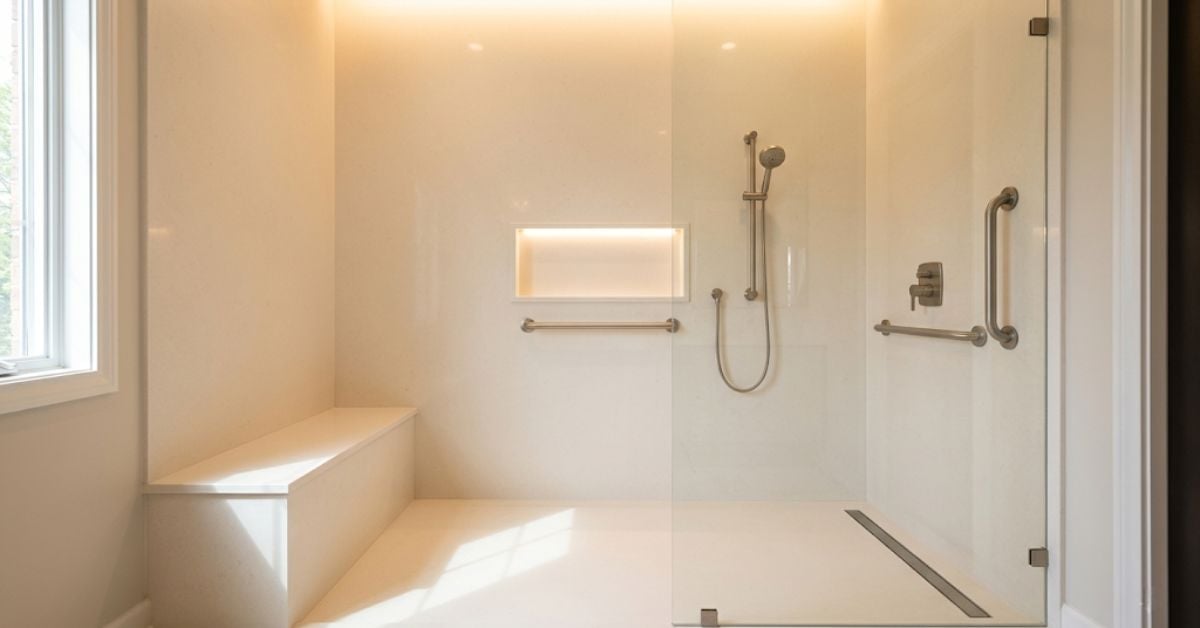
Where the 89 Percent Number Comes From — and Why It Matters
The NKBA is the largest professional association for kitchen and bath designers in North America — its annual trend report surveys hundreds of designers, remodelers, and product manufacturers about what homeowners actually specify during real projects. When the 2026 report shows 89 percent of homeowners now request fewer or no grout lines, that reflects tens of thousands of individual design consultations across every US market — not a small survey or a marketing pitch.
Houzz’s 2025 US Bathroom Trends Study reaches the same conclusion from a different angle. Their data shows 68 percent of upgraded showers now use large-format materials (panels or slabs), with small-tile installations having declined from 60 percent to under 30 percent of upgrades over five years. Fixr’s 2026 remodeling report identifies groutless surfaces as one of the top three fastest-rising material categories in bathrooms.
The three sources reach the same conclusion using different methodology. When independent industry data converges on a number that strongly, it reflects a real market shift — not a passing trend.
Why the Shift Is Happening in 2026 Specifically
Grout has always been the weakest point of a tile shower. What changed in 2026 is that homeowners now have a viable alternative — one that photographs as luxury design rather than a compromise. Three converging factors put the shift into overdrive this cycle:
1. Composite Stone Panels Reached Design Maturity
Ten years ago, groutless shower alternatives meant acrylic surrounds — a material that saved on maintenance but read as plastic in bright light and photographed poorly in home listings. Composite stone panels (with 60 to 80 percent natural stone content bonded with polymer resin) now deliver a genuine stone aesthetic with the maintenance benefits of a non-porous surface. The material category has matured to the point where a designer specifying “warm-veined stone panels” is delivering premium finish quality — not compromise.
2. Reddit and Social Media Amplified Grout Regret
Homeowner discussion threads on renovation forums have named grout as the top material regret in bathroom remodels for years. Recurring comments describe grout as “the bane of my existence,” complain about impossible-to-remove mildew stains, and explicitly warn future remodelers to avoid it. This grassroots feedback has changed how first-time remodelers approach the material decision — they now arrive at the consultation already having decided against grout, rather than being sold on the alternative.
3. Aging in Place Made Low-Maintenance a Priority
Sixty-eight percent of homeowners now intentionally build accessibility features into bathrooms from the design stage, and low-maintenance surfaces align with that priority. Grout scrubbing is physically demanding work that becomes progressively harder as the homeowner ages. Choosing a groutless shower during a 2026 remodel is choosing a bathroom that continues to be maintainable for the next 20 years of homeownership.
The Grout Maintenance Reality in a Piedmont Climate
North Carolina’s humid summers make grout maintenance meaningfully harder than in drier climates. Warm, moist air holds mold and mildew spores that colonize porous surfaces — and grout is one of the most porous materials in a modern bathroom. Here is what the maintenance burden actually looks like for a typical NC homeowner with a tile shower:
| Frequency | Task | Time Investment |
|---|---|---|
| Weekly | Wipe down and squeegee to slow mildew growth | 15–20 minutes per week |
| Monthly | Scrub grout lines with a stiff brush and mildew cleaner | 1–2 hours per month |
| Quarterly | Deep clean with oxygen bleach or dedicated grout cleaner | 2–3 hours per session |
| Annually | Re-seal all grout lines with penetrating sealer | 3–4 hours plus 24 hours drying time |
| Every 5–10 Years | Regrout — remove old grout, re-apply, re-seal | $800–$2,000 professional job or full weekend DIY |
The honest math: A conscientious NC homeowner spends 25 to 40 hours per year maintaining a tile shower’s grout — and every 5 to 10 years, the whole system requires professional regrouting to restore its appearance and water resistance. Over a 20-year period, that is 500 to 800 hours of scrubbing plus 2 to 4 regrouting events at $800 to $2,000 each. The grout-free alternative eliminates all of it.
Why the Grout Problem Gets Worse Over Time — Not Better
A common assumption is that grout maintenance becomes routine after the first few years and effort levels off. The reality is the opposite. Three compounding factors make maintenance progressively harder over the life of a tile shower:
Grout Absorbs More Contamination Over Time
Even sealed grout is porous at the microscopic level. Over years of exposure to soap, mineral deposits, body oils, and mildew spores, the pore structure fills with organic residue that no cleaning product fully removes. Grout at year 8 requires meaningfully more scrubbing to reach the same visual result as grout at year 2 — because more contamination sits inside the material rather than on its surface.
Sealer Effectiveness Decreases
Penetrating grout sealers wear off with cleaning and abrasion, requiring re-application annually. But each re-sealing seats less deeply than the previous one because the pore structure is already partially occupied by contamination. By year 10, sealer applications provide much less protection than they did in the first year.
Physical Limitations Compound
Scrubbing grout requires sustained kneeling, awkward reaching, and repetitive wrist and shoulder motion. These tasks become progressively harder as homeowners age, which is exactly the population most likely to be in the home long enough to face the compounded maintenance burden. Aging-in-place homeowners choosing a tile shower are choosing a maintenance obligation they will struggle to meet in their 70s and 80s.
What “Grout-Free Shower” Actually Means
Not all groutless shower options are equal. There are three distinct product categories that deliver a grout-free experience, and the aesthetic and cost differences between them are meaningful.
Composite Stone Panels (Onyx Collection, similar)
60–80% natural stone particles bonded with polymer resin. Large-format panels (60″×96″ typical) with minimal seams. Non-porous, no sealing required, looks and feels like natural stone.
Cost range: $5,000–$10,000 installed. Aesthetic: premium luxury stone.
Natural Stone Slab
Quarried marble, granite, or travertine cut into large slabs. True natural stone, but porous — requires periodic sealing. Beautiful but heavy and expensive to install.
Cost range: $12,000–$25,000+ installed. Aesthetic: highest luxury tier.
Acrylic Shower Surround
Thermoformed plastic panels. Non-porous and grout-free, but lightweight and photographs as plastic in bright light. Common with national franchise operators.
Cost range: $3,000–$7,000 installed. Aesthetic: functional, not premium.
The 2026 sweet spot: For most homeowners, composite stone panels hit the practical intersection of premium aesthetic, non-porous maintenance benefits, and reasonable cost. They deliver the visual quality of natural stone without the sealing obligation, at roughly half the cost of natural stone slab. Our approach across Lake Norman stone shower installations, Matthews stone shower work, and other NC projects uses this material category consistently for exactly these reasons.
The Resale Effect — What Buyers See in 2026
Buyer preferences in the NC market have shifted meaningfully in the past five years. Where a tiled shower with hand-laid stone accents once represented premium bathroom finish, a groutless composite stone shower now delivers the same premium signal without the buyer objection of anticipated maintenance work.
What Buyers See in a Tile Shower Today
- Ongoing maintenance obligation they will inherit.
- Visible discoloration in older grout that suggests hidden problems.
- Higher probability of a regrouting or replacement decision within their first 10 years of ownership.
- Design that reads as “current when installed” rather than “current today.”
What Buyers See in a Grout-Free Composite Stone Shower
- Premium luxury finish they don’t have to maintain.
- Contemporary design that will still read as current in 10 years.
- No visible grout lines suggesting hidden mildew or water damage.
- A remodel decision made by an owner who chose quality materials over the cheapest option.
FAQ — Grout-Free Showers
Do composite stone panels really have zero grout lines?
Effectively, yes. Panels are joined with color-matched sanitary silicone at the wall-to-wall corners and around fixtures — not with grout. The silicone seams are typically 1/8 inch wide, precisely aligned, and blend into the panel color. They last 15 to 20 years with no maintenance and can be re-applied when eventually needed. Compared to the 3 to 6 percent of wall surface that is grout in a tile shower, silicone seams represent under 0.5 percent of the wall surface in a panel shower — a functionally different situation.
Can I get a grout-free look with tile if I use large-format tile with tight grout lines?
Partially. Large-format porcelain tile with minimal 1/16-inch grout lines dramatically reduces grout surface area compared to traditional subway tile. It’s a legitimate middle-ground option — better than small-tile grout, not as maintenance-free as composite stone panels. Grout is still present and still requires sealing and periodic cleaning. If minimum maintenance is the priority, composite stone panels still win. If tile design flexibility is the priority, large-format porcelain with tight grout is a reasonable compromise.
Are grout-free showers more expensive than tile?
Depends on the tile. A composite stone panel installation typically runs $5,000 to $10,000 installed. Basic ceramic subway tile can cost less ($4,000 to $8,000). Premium designer tile with intricate patterns costs more ($8,000 to $14,000). The honest comparison over a 20-year period, factoring in grout maintenance labor, regrouting events, and the resale advantage of groutless surfaces, typically favors composite stone panels even when the upfront cost is slightly higher.
Will a grout-free shower work in my older NC home?
Yes. Composite stone panels install in essentially any residential shower footprint — historic homes in Salisbury and Winston-Salem, mid-century ranches, 1990s builds, and newer luxury homes. The installation adapts to the existing framing and plumbing. Older homes may need substrate correction and plumbing updates during installation (which any quality shower renovation should include regardless of material choice), but the panel material itself is not a limiting factor.
Where can I see grout-free shower samples in person?
A qualified local installer brings full-size samples to an in-home consultation. Carolina Creek Tub & Shower includes the full composite stone panel sample range in consultations across Davidson custom stone shower work, Cornelius stone shower installations, Huntersville custom shower installation, and every other city in our NC service area — so you can hold the material, compare colors and veining in your own lighting, and coordinate them with your bathroom’s overall design.
Grout-Free Composite Stone Shower Services Across NC
- Premium Stone Shower Design Lake Norman — composite stone shower installations across the Lake Norman region.
- Custom Stone Shower Installation Davidson, NC — Davidson composite stone shower design.
- Custom Stone Shower Cornelius, NC — Cornelius composite stone shower installations.
- Stone Shower Installation Matthews, NC — Matthews composite stone shower design and installation.
- Custom Shower Installation Huntersville — Huntersville composite stone shower work.
- Custom Shower Design Mint Hill — Mint Hill composite stone shower installations.
See a Grout-Free Shower Sample at a Free Consultation
Full-size composite stone panel samples brought to your home. Honest comparison against tile and other alternatives. Itemized written quotes. Lifetime warranty on every installation. Serving all of North Carolina.