Get a Free Comfort Height Toilet Today
Does Medicare Cover a Walk-In Tub? Coverage, Tax Deductions, and VA Benefits Explained (2026)
No
Original Medicare (Parts A & B) does not cover walk-in tubs
Sometimes
Medicare Advantage supplemental benefits
Yes
VA grants (HISA, SAH, SHA) for eligible veterans
Deductible
As medical expense under IRS Pub 502 (with conditions)
Important: This guide summarizes federal Medicare, Medicaid, VA, and IRS rules in effect for 2026 in plain language. Coverage rules change annually and vary by plan, state, and individual eligibility. Nothing on this page is medical, tax, or legal advice. Confirm your specific eligibility with your Medicare plan administrator, your state Medicaid office, the VA, or a licensed tax professional before making financial decisions.
Walk-in tubs are one of the most researched accessibility purchases in the home — and one of the most confusing to finance. The short version is straightforward: Original Medicare does not pay for one. But the longer version is more useful, because several other coverage pathways do exist, and a walk-in tub can also be a legitimate medical tax deduction under specific conditions.
This guide walks through each of the five coverage and cost-reduction pathways available to a walk-in tub buyer in 2026 — Original Medicare, Medicare Advantage, Medicaid Home and Community-Based Services waivers, VA benefits, and the IRS medical expense deduction. Each section is written to answer the specific question a homeowner is really asking: “Does this apply to me, and what would I actually need to do?”
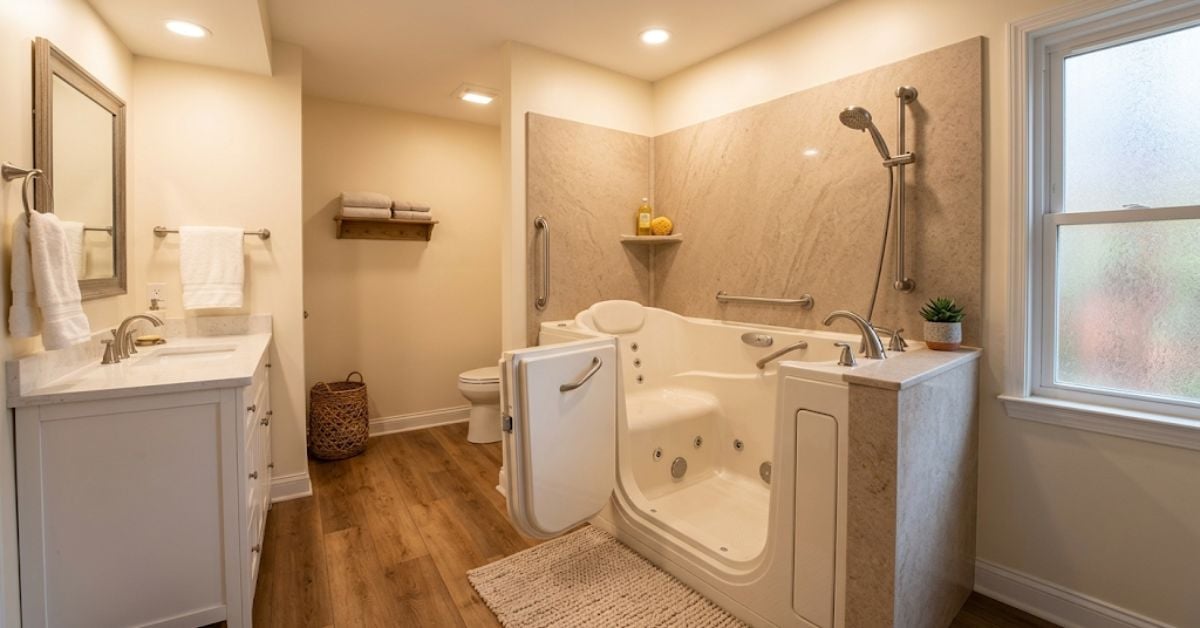
Original Medicare (Parts A and B) — Does Not Cover
Original Medicare — the federal program most people mean when they say “Medicare” — does not pay for walk-in tubs, and this has not changed for 2026. The reason is technical but important: Medicare covers durable medical equipment (DME) that is medically necessary and primarily useful in a home. Walk-in tubs do not meet Medicare’s DME definition because they are considered a home modification rather than portable medical equipment.
The distinction matters because it explains why other bathroom equipment can be covered while walk-in tubs are not. A shower chair prescribed by a doctor is DME and may be covered. A raised toilet seat is DME and may be covered. A hospital bed for home use is DME and is generally covered when medically necessary. A walk-in tub is classified as a home modification and falls outside the DME category, regardless of medical necessity.
What Original Medicare Does Cover in an Accessibility Context
- Shower chairs and transfer benches — covered as DME with a physician prescription.
- Raised toilet seats and commodes — covered as DME.
- Walkers, canes, and wheelchairs — covered as DME.
- Hospital beds for home use — covered as DME when medically necessary.
What Original Medicare does not cover: walk-in tubs, grab bars (as a fixture), curbless shower installation, doorway widening, ramps, or any structural bathroom modification.
Medicare Advantage (Part C) — Sometimes Covers
Medicare Advantage plans are private insurance plans that replace Original Medicare. They must cover everything Original Medicare covers, but they can also offer additional supplemental benefits — and this is where walk-in tub coverage sometimes appears.
Since 2020, Medicare Advantage plans have been allowed to offer Special Supplemental Benefits for the Chronically Ill (SSBCI). These benefits can include home modifications for enrollees who meet chronic-illness criteria and whose plan chooses to offer them. Some plans include allowances specifically for bathroom accessibility modifications, which may cover partial walk-in tub costs.
How to Check Your Medicare Advantage Plan
- Review your plan’s Evidence of Coverage document — look for “home modifications,” “bathroom safety,” or “SSBCI” language.
- Call your plan’s member services line — ask specifically whether walk-in tubs are covered under any supplemental benefit, and what documentation is required.
- Ask about pre-authorization requirements — plans that do cover typically require prior approval before the installation, not reimbursement after.
- Get a physician’s letter of medical necessity — required by virtually every plan that offers any coverage.
The honest expectation: Most Medicare Advantage plans in 2026 still do not cover walk-in tubs, and among the plans that do, the covered amount is typically partial — often $500 to $2,000 toward a total installation cost that runs $9,000 to $18,000. Full coverage of a walk-in tub through Medicare Advantage is rare. Check your specific plan; do not assume.
Medicaid Home and Community-Based Services (HCBS) — Sometimes Covers
Medicaid HCBS waivers are state-administered programs designed to help eligible individuals remain in their own homes rather than moving into institutional care. In many states, HCBS waivers include home modification benefits that can cover walk-in tubs, grab bar installation, curbless showers, and other accessibility modifications when medically necessary.
In North Carolina, Medicaid HCBS waivers are administered under several programs — the Community Alternatives Program for Disabled Adults (CAP/DA), Innovations Waiver, and others. Home modification benefits under these programs vary by waiver and by lifetime cap. Eligibility depends on income, medical need, and enrollment in the specific waiver program.
Who Should Check Medicaid HCBS Coverage
- Individuals already enrolled in a NC Medicaid HCBS waiver — check with your case manager about home modification benefits.
- Individuals who meet income and disability criteria but are not yet enrolled — waiver enrollment can take time; start the application well before you need the modification.
- Adults over 65 with limited income — the CAP/DA waiver specifically supports aging in place.
Contact the NC Department of Health and Human Services or your local Area Agency on Aging for eligibility assessment. Application timelines vary from weeks to many months depending on program.
VA Benefits — Multiple Programs, Real Coverage
For eligible veterans, the Department of Veterans Affairs offers several grant programs specifically designed for home modifications, including walk-in tub installation, curbless shower conversion, and broader bathroom accessibility work. These are the most robust coverage pathways available for accessibility bathroom modifications in the United States, and they are meaningfully underused.
HISA — Home Improvements and Structural Alterations Grant
The HISA grant is the most commonly used program for bathroom modifications. As of 2026, HISA provides up to $6,800 lifetime for veterans with service-connected disabilities and up to $2,000 lifetime for veterans with non-service-connected disabilities. Coverage includes walk-in tubs, curbless shower conversions, grab bar installation, ramps, and other accessibility modifications. Application is submitted through the VA prosthetics office, and a physician’s prescription is required.
SAH — Specially Adapted Housing Grant
SAH is a much larger grant program for veterans with specific severe service-connected disabilities — including loss of use of both legs, severe vision impairment, and other qualifying conditions. As of 2026, SAH provides up to approximately $117,000 lifetime for adapting or purchasing a home to accommodate the disability. Bathroom accessibility work qualifies as adapted-housing scope.
SHA — Special Housing Adaptation Grant
SHA is the sister program to SAH, designed for veterans with specific service-connected disabilities that are severe but do not meet the full SAH criteria. As of 2026, SHA provides up to approximately $23,000 lifetime. Bathroom accessibility work is a common use.
Where to start for veterans: Contact your VA prosthetics office or your VA Medical Center’s social worker to begin the HISA application. For SAH or SHA, contact your regional VA benefits office. Grant amounts are indexed annually; the 2026 figures above are approximate and should be verified with the VA directly before making purchase commitments.
IRS Medical Expense Deduction — Yes, With Conditions
Walk-in tubs installed primarily for medical reasons can be deducted as a medical expense on federal income taxes under IRS Publication 502. This is one of the most useful cost-reduction pathways available, and it applies regardless of Medicare or VA eligibility. But it comes with specific rules that matter.
The 7.5% Adjusted Gross Income Threshold
Medical expenses are deductible only to the extent they exceed 7.5 percent of your adjusted gross income (AGI). For a household with $80,000 AGI, only medical expenses above $6,000 in a tax year are deductible. Combined with other qualifying medical expenses in the same year, a walk-in tub installation can push a household over the threshold and produce meaningful tax savings.
The “Value Added to the Home” Adjustment
Home modifications are only deductible to the extent they exceed the value they add to the home. If a walk-in tub adds $2,000 to your home’s fair market value but costs $12,000 installed, the deductible portion is $10,000. In practice, walk-in tubs typically add very little to market value in a general-market sale (they narrow the buyer pool), so most of the cost is usually deductible — but the calculation matters.
Documentation Required
- Physician’s letter of medical necessity — must specifically identify the condition and recommend the walk-in tub as a treatment or accommodation.
- Itemized installation invoice — showing tub cost, installation labor, and any related plumbing or water heater work.
- Home value assessment — to calculate the deductible portion after the value-added adjustment.
- All receipts and documentation kept for seven years in case of IRS audit.
Consult a tax professional: The medical expense deduction is legitimate and well-established, but the specifics matter. A CPA or enrolled agent familiar with medical expense deductions can confirm the deductible portion for your specific situation, ensure documentation is adequate, and help you time the installation to maximize the tax benefit. The cost of a professional consultation typically pays for itself several times over in this context.
Combining Programs — What Actually Stacks
A walk-in tub buyer can often use multiple programs together to reduce total out-of-pocket cost meaningfully. The stacking rules matter, though — some combinations are allowed, some are not.
| Combination | Allowed? | Notes |
|---|---|---|
| VA HISA grant + IRS medical deduction | Yes | Deduct only the out-of-pocket portion after the grant. |
| Medicare Advantage supplemental + IRS medical deduction | Yes | Deduct only the out-of-pocket portion after plan coverage. |
| Medicaid HCBS + IRS medical deduction | Yes | Deduct only the out-of-pocket portion after waiver coverage. |
| Multiple VA grants for same modification | No | One VA grant per modification; you choose which program. |
| VA HISA + Medicare Advantage supplemental | Depends | Coordination rules apply; consult both program administrators. |
A Practical Sequence for a Walk-In Tub Buyer
1
Get a physician’s letter of medical necessity first
Required by virtually every coverage pathway. Should specifically name the condition, describe how a walk-in tub addresses it, and be dated within the last 12 months.
2
Check every coverage pathway that might apply
Call your Medicare Advantage plan member services (if applicable). Contact your VA prosthetics office (if applicable). Check Medicaid HCBS eligibility (if applicable). Note which programs would cover what portion.
3
Get an itemized quote from a qualified installer
Coverage programs require an itemized quote showing every line item. National franchise operators often refuse to provide this level of detail; established local installers deliver it as standard practice.
4
Submit pre-authorization requests before installation
Virtually every coverage program requires pre-authorization before the installation — not reimbursement after. Installing first and asking for coverage later usually fails.
5
Keep every receipt for the tax deduction
Even if other programs cover a portion, the out-of-pocket balance is deductible under IRS Pub 502 subject to the 7.5% AGI threshold. Keep documentation for seven years.
FAQ — Walk-In Tub Coverage and Financing
Can I get a walk-in tub through Medicare?
Not through Original Medicare (Parts A and B). Some Medicare Advantage (Part C) plans offer supplemental benefits that may cover partial cost, but full coverage is rare. Check your specific plan’s Evidence of Coverage document or call your plan’s member services line.
How do I get a physician’s letter of medical necessity?
Ask your primary care physician during an appointment. The letter should identify your specific medical condition (arthritis, joint replacement recovery, mobility limitation, fall risk, circulation condition), explain how a walk-in tub reduces medical risk or improves treatment, and be dated within the past 12 months. Most physicians will provide this for eligible patients as part of routine care.
Are walk-in tubs tax deductible?
Yes, under IRS Publication 502 as a medical expense — with two conditions. First, the total medical expenses for the tax year must exceed 7.5 percent of adjusted gross income. Second, the deductible portion is reduced by any value the walk-in tub adds to the home’s fair market value (typically small for a walk-in tub). Consult a tax professional for your specific situation.
What VA benefits cover walk-in tubs for veterans?
Three primary programs: HISA (up to $6,800 for service-connected disabilities or $2,000 for non-service-connected, most commonly used for bathroom modifications), SAH (up to approximately $117,000 for veterans with specific severe service-connected disabilities), and SHA (up to approximately $23,000 for eligible veterans not qualifying for SAH). Contact your VA prosthetics office or regional VA benefits office to apply. Amounts adjust annually.
Where can I get an itemized walk-in tub quote in North Carolina?
Coverage and tax documentation both require an itemized installation quote. Established local installers deliver this as standard practice. Carolina Creek Tub & Shower provides fully itemized written quotes for walk-in tub installations across Matthews, Davidson, and the broader Charlotte metro and Lake Norman region — with owner-led consultations and lifetime installation warranties.
Related Walk-In Tub and Accessible Bathroom Services
- Walk-In Tub Installation Davidson, NC — walk-in tub installation with itemized quotes for coverage and tax documentation.
- Walk-In Tub Design Matthews, NC — Matthews walk-in tub installation for accessible bathing.
- Walk-In Tub for Aging in Place Lake Norman — Lake Norman walk-in tub installations for long-term safety.
- Accessible Bathroom Design Cornelius — full accessible bathroom design across the Lake Norman area.
- Custom Stone Shower Installation Davidson, NC — curbless stone showers as an accessibility alternative to walk-in tubs.
- Custom Stone Shower Cornelius, NC — Cornelius stone shower installations designed for aging in place.
Get an Itemized Walk-In Tub Quote in North Carolina
Owner-led consultations, itemized written quotes suitable for VA, Medicare Advantage, Medicaid HCBS, and IRS documentation, and a lifetime warranty on every installation. Serving North Carolina veterans and homeowners.