Get a Free Comfort Height Toilet Today
Grab Bars That Don’t Look Like Grab Bars — Designer Accessibility Hardware for 2026
68%
Homeowners now build in accessibility from design stage
250 lb
Minimum load rating for a proper grab bar
4 Finishes
Now standard in designer accessibility hardware
Lifetime
Warranty on every Carolina Creek install
Ten years ago, adding grab bars to a bathroom meant accepting a medical-facility look — bright chrome tubes bolted to plain tile walls, screaming their function from across the room. That has changed. The 2026 accessibility hardware market has caught up to the reality that 68 percent of homeowners now build accessibility features into their bathrooms from the design stage — and those homeowners overwhelmingly want their bathrooms to look like great design, not rehabilitation suites.
This guide explains what “designer grab bars” actually are, how they achieve the same structural safety as traditional medical hardware, the four finishes now standard across quality manufacturers, the six specific design choices that separate a bathroom that looks accessible from one that just is accessible, and where these grab bars should actually go for both function and daily use.
Why Institutional Grab Bars Stopped Being the Only Option
Traditional medical-grade grab bars developed for hospital and long-term-care settings prioritized one thing above everything else — the ability to demonstrate ADA compliance to a regulator. They were bright chrome (highly visible), uniform diameter (typically 1-1/4 or 1-1/2 inches), and installed with obvious mounting brackets. Their design language was borrowed directly from institutional environments, and homeowners installing them at home inherited that aesthetic whether they wanted it or not.
This mattered less when accessibility hardware was mostly added later in life, at the point when function trumped everything. It matters much more now — the average age at which homeowners first install accessibility hardware has dropped meaningfully, and the design decision is being made during full bathroom remodels rather than as reactive add-ons. A bathroom being remodeled at $22,000 or $32,000 with everything else coordinated is not going to accept a $30 medical-grade chrome grab bar as the visual outlier that defines the room.
The market has responded. Every major hardware manufacturer — Moen, Delta, Kohler, and specialty accessibility brands — now offers designer grab bar collections that coordinate with the same fixture families as their showerheads, towel bars, cabinet pulls, and toilet accessories. The load ratings are identical to medical-grade hardware (typically 250 to 500 pounds of pull load). The functional performance is identical. Only the aesthetic has changed.
What “Designer Grab Bars” Actually Are
Designer grab bars are structurally reinforced accessibility hardware manufactured to meet or exceed ADA-informed load ratings, but designed to visually integrate with the rest of a bathroom’s hardware program. Four things distinguish them from institutional medical hardware:
1. Coordinated Finishes
The single most impactful visual change. Instead of bright chrome only, designer grab bars are now available in brushed nickel, matte black, oil-rubbed bronze, and champagne bronze — the same finishes as the faucets, towel bars, showerheads, and cabinet pulls in a modern bathroom. When the grab bar matches the finish of everything else in the room, it stops reading as accessibility hardware and starts reading as intentional design.
2. Sculptural Profile and Diameter
Medical-grade grab bars use uniform tube stock. Designer grab bars use varied diameters (1-1/4 to 1-3/4 inches), tapered profiles, and integrated escutcheon plates that hide mounting hardware. The tactile grip is often better than institutional versions — knurled or subtly textured grip zones instead of smooth chrome tubes.
3. Multi-Function Design
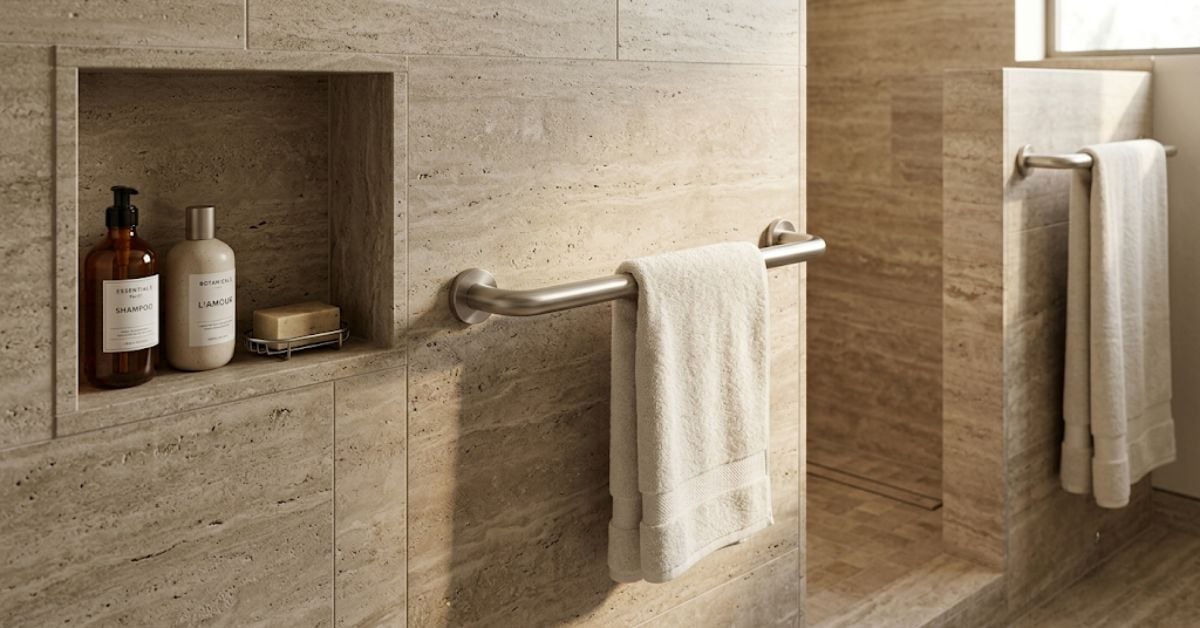
Many designer grab bars double as towel bars, robe hooks, or integrated shelves. A properly reinforced towel bar in the bathroom can serve as both a hanging surface for a hand towel and a structural grab point during a stumble. This category — sometimes called “hidden” or “invisible” accessibility hardware — has grown rapidly in the 2026 market because it eliminates the visual signal of grab bar presence entirely.
4. Concealed Mounting Systems
Institutional grab bars typically show visible mounting screws and exposed flanges. Designer versions use concealed mounting plates that clip over the wall attachment, leaving no visible fasteners. The grab bar appears to grow out of the wall rather than being bolted onto it.
The Six Design Choices That Make Grab Bars Disappear Into a Room
1
Match every grab bar to the rest of the bathroom hardware finish.
If your faucets and cabinet pulls are brushed nickel, the grab bars are brushed nickel. If everything else is matte black, so are the grab bars. Mixing bright chrome grab bars with brushed nickel hardware is the single strongest institutional signal.
2
Use towel-bar-and-grab-bar dual-purpose hardware where possible.
A structurally reinforced towel bar anchored into wall blocking looks like a towel bar to any guest and functions as a grab bar when needed. This is the most effective single strategy for making accessibility invisible.
3
Add wall blocking during the remodel — even where you don’t currently want grab bars.
Blocking behind the drywall in every wet-zone wall (shower, toilet area, tub area) costs almost nothing during a remodel and makes future grab bar installation trivial. Retrofitting blocking into a finished bathroom later is expensive and disruptive. Do it now.
4
Use integrated stone bench seats in the shower instead of fold-down plastic units.
A built-in stone bench matching the shower wall material reads as intentional design and often provides useful storage underneath. A fold-down white plastic ADA bench is the strongest institutional signal short of hospital grab bars.
5
Choose a handheld showerhead on an adjustable slide bar as standard luxury spec.
Slide-bar handhelds are common in luxury showers regardless of accessibility. Pairing one with a wall-mounted rainhead reads as premium two-head spec, while the handheld also serves seated shower use with no visual accessibility signal.
6
Anchor with warm materials and coordinated palette.
Warm neutrals — off-whites, warm grays, natural wood tones — automatically push a bathroom’s aesthetic away from clinical. Cool grays and stark whites read as institutional regardless of hardware quality. Warm materials with tactile texture create the residential feel accessibility hardware then integrates into.
The Four Finishes Now Standard in Designer Accessibility Hardware
| Finish | Best For | Practical Notes |
|---|---|---|
| Brushed Nickel | Transitional and traditional bathrooms; the most versatile choice | Hides water spots and fingerprints well; coordinates with most tile and stone panel colors. |
| Matte Black | Contemporary and modern-farmhouse bathrooms; the strongest visual contrast | Shows water spots and dust; slightly higher maintenance but very high visual impact. |
| Oil-Rubbed Bronze | Traditional, rustic, and craftsman-style bathrooms | Rich warm tone; naturally hides fingerprints; ages gracefully over time. |
| Champagne Bronze | Contemporary luxury bathrooms with warm palettes | The 2026 rising finish; warmer than brushed nickel, more contemporary than oil-rubbed bronze. |
The coordination principle: Pick one finish for your bathroom and use it for every grab bar, faucet, showerhead, cabinet pull, towel bar, robe hook, and toilet accessory. Intentional mixed-metal combinations (matte black with brushed gold, brushed nickel with champagne bronze) are a legitimate 2026 direction — but they must be deliberate throughout the room, not accidental. Similar to our Cornelius accessible bathroom work, coordination is applied consistently across every element from grab bars to shower door hardware.
The Technical Requirements Behind Every Grab Bar
Designer aesthetics do not change the structural requirements. Every grab bar in a bathroom — no matter how beautiful its finish — must meet the same load and installation standards to actually function during a fall.
Wall Blocking Is Non-Negotiable
Grab bars must anchor into structural wall backing — plywood or reinforced blocking installed between wall studs, rated to hold 250 pounds of pull load at any angle. Grab bars mounted directly into drywall with plastic anchors fail at the moment they are needed most. Any installer who tells you they can add grab bars to a finished wall “with the right anchors” is describing a hardware installation that will not save someone during a fall. Blocking must be there.
Placement Standards
ADA-informed placement puts grab bars at these positions:
- Behind the toilet: Horizontal, 33 to 36 inches above the floor, at least 36 inches long, positioned so the near end is 12 inches or less from the rear wall.
- Beside the toilet (side wall): Horizontal, 33 to 36 inches above the floor, at least 42 inches long, positioned so the near end is 12 inches or less from the rear wall.
- Inside the shower (control wall): Vertical, positioned near the entry, so a user can grab it while stepping in or out.
- Inside the shower (back wall): Horizontal, at seated height (about 33 inches) if there is a bench seat, or standing height (about 36 inches) without one.
- Beside the tub (if walk-in tub): Horizontal, near the entry door, at a height that supports entry and exit.
Where to Add “Just in Case” Blocking
During a bathroom remodel, add blocking to every wet-zone wall — shower control wall, back wall, entry wall; toilet rear wall and side wall; and behind the vanity where a stabilizing bar could go later. Even if you install no grab bars today, the blocking makes future additions cost roughly $150 to $300 per bar in labor and hardware. Without blocking, the same additions require opening walls and cost 5 to 10 times more.
Cost Ranges for Designer Grab Bars in 2026
| Tier | Cost per Grab Bar | Included Features |
|---|---|---|
| Basic Designer | $45–$90 | Single-finish grab bar, standard diameter, visible mounting hardware. |
| Mid-Tier Designer | $90–$180 | Concealed mounting, coordinated with hardware family, multi-finish options, tactile grip zones. |
| Premium Designer | $180–$350 | Multi-function (towel bar + grab bar hybrids), premium finishes (champagne bronze, brushed gold), sculptural profiles. |
| Luxury / Custom | $350+ | Custom lengths, integrated ledges or shelves, top-tier finish families, coordinated to a full custom bathroom hardware program. |
Installation labor for each grab bar into pre-installed wall blocking typically runs $75 to $150 depending on complexity. A typical accessible bathroom uses 3 to 5 grab bars total — so total grab bar spend for a Tier 3 accessible bathroom remodel using mid-tier designer hardware runs roughly $700 to $1,500 installed. This is a small fraction of the total remodel budget for a meaningful daily-life and safety upgrade.
FAQ — Designer Grab Bars and Accessibility Hardware
Are designer grab bars as strong as medical-grade ones?
Yes. Every grab bar sold in the US, whether marketed as designer or medical-grade, is rated to hold at least 250 pounds of pull load and typically 500 pounds when properly installed into wall blocking. Manufacturers publish load ratings on product spec sheets. What matters more than the grab bar itself is the wall blocking behind it — a $50 medical-grade bar installed into proper blocking will outperform a $300 designer bar mounted in drywall with plastic anchors.
Can I install designer grab bars in a bathroom that already exists — without a full remodel?
Only if there is already wall blocking behind the drywall — which most existing bathrooms do not have. Adding proper blocking to a finished bathroom requires opening the walls, which effectively becomes a partial remodel. This is why the strongest recommendation for anyone doing any bathroom remodel is to add blocking during the remodel — even before you think you need grab bars.
Which brands make the best designer grab bars in 2026?
Moen, Delta, and Kohler all offer designer grab bar collections that coordinate with their broader bathroom hardware lines — which is the biggest advantage, because your grab bars automatically match your faucets and cabinet pulls when you buy from the same family. Specialty accessibility brands like Great Grabz and Grabcessories offer more design-forward multi-function options. A qualified installer brings samples from multiple manufacturers to consultation so you can compare finishes and profiles in person.
Do designer grab bars affect resale value?
Not negatively — and typically positively. When installed with coordinated finishes and proper design integration, designer grab bars read as intentional luxury design rather than accessibility accommodation. 68 percent of homeowners now intentionally build accessibility features into their bathrooms from the design stage, and buyer preference has followed. A well-designed accessible bathroom appeals to a broader buyer pool than a builder-grade dated bathroom.
Where can I see designer grab bars in person?
A qualified installer brings samples to an in-home consultation. Carolina Creek Tub & Shower includes designer accessibility hardware samples in consultations across accessible bathroom projects in Cornelius, Matthews walk-in tub installations, and every other city in our service area — so you can hold the material, compare finishes under your own lighting, and coordinate them with your chosen bathroom hardware family.
Related Accessibility Services
- Accessible Bathroom Design Cornelius — full accessible bathroom design in the Lake Norman area.
- Walk-In Tub Installation Davidson, NC — walk-in tub installation with coordinated accessibility hardware.
- Walk-In Tub Design Matthews, NC — Matthews walk-in tub with designer accessibility hardware.
- Walk-In Tub for Aging in Place Lake Norman — Lake Norman walk-in tub installations.
- Custom Stone Shower Installation Davidson, NC — curbless stone showers with integrated accessibility.
- Custom Stone Shower Cornelius, NC — Cornelius stone shower installations with designer grab bar integration.
See Designer Grab Bars in Person at a Free Consultation
Full accessibility hardware samples brought to your home. Proper wall blocking installed during every remodel. Designer grab bars in every major finish, coordinated with your bathroom hardware program. Lifetime warranty on every installation.