Get a Free Comfort Height Toilet Today
Comfort-Height Toilets and Bathroom Fixtures – Small Upgrades With Outsized Daily Impact
2–4″
Comfort-height toilet difference from standard
7 Fixtures
Small upgrades with outsized daily impact
$50–$600
Typical per-fixture upgrade premium
Lifetime
Warranty on every Carolina Creek install
Bathroom remodel budgets tend to concentrate on the visible showcase items — the shower, the vanity, the tile, the flooring. What often gets left as afterthought is the collection of small fixtures that people actually touch, use, and interact with several times a day. Toilets that are two inches too low. Faucets that require two hands to adjust. Showerheads that are permanently mounted at the wrong height. Toilet paper holders three feet from the toilet. None of these individually feels like a decision worth much attention during design. All of them together define whether the finished bathroom is comfortable or subtly annoying every single day.
This guide walks through seven small fixture upgrades that deliver outsized daily impact relative to their cost — from the comfort-height toilet that spares your knees every trip to the bathroom, to the single-lever faucet with temperature memory that means never scalding yourself when you’re half asleep, to the designer-style grab bar that reads as sculptural rather than institutional and can be installed today rather than waiting for aging in place to become urgent. Each section covers what the upgrade actually is, why it matters in daily use, the cost premium over builder-grade default, and where the trade-off lies.
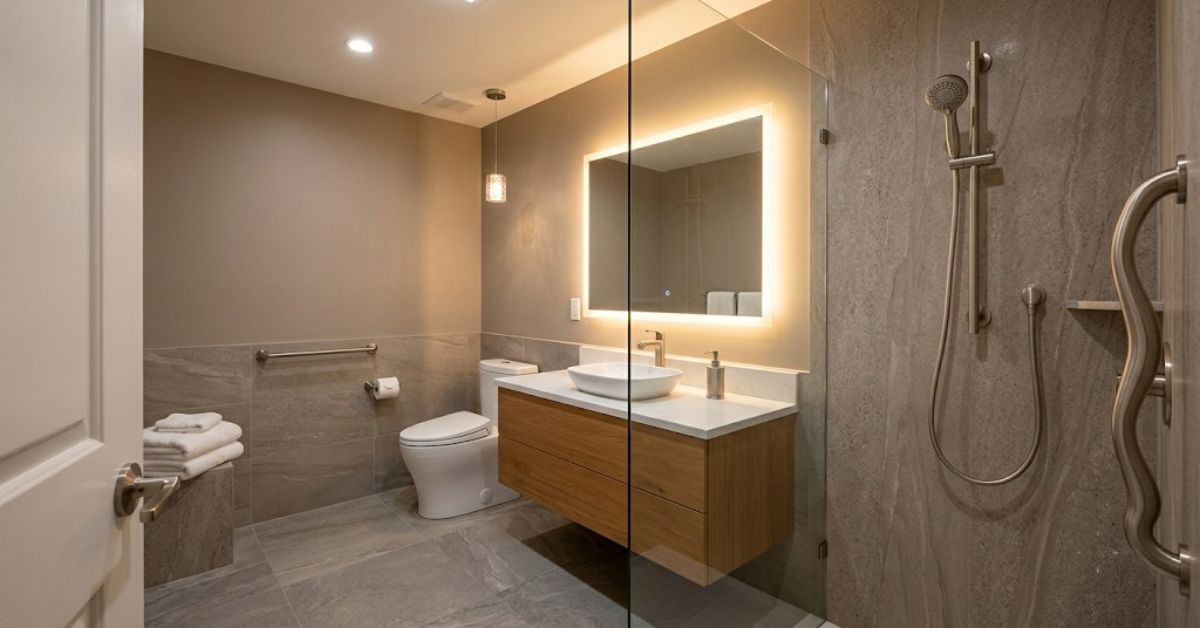
Upgrade 1: Comfort-Height Toilet Over Standard-Height
What it is: A toilet with seat height at approximately 17 to 19 inches from finished floor, versus the traditional standard of 14 to 15 inches. The difference is 2 to 4 inches — small on paper, meaningful in the knees, hips, and lower back every time you sit down and stand up.
Why it matters daily: Comfort-height toilets sit at approximately the same height as a standard chair. Standing up from a comfort-height toilet uses the same muscles as standing up from a dining chair. Standing up from a standard-height toilet uses noticeably more knee and quad effort. Homeowners under 40 rarely notice the difference. Homeowners over 55, anyone with knee or hip issues, taller adults, and pregnant women feel the difference immediately.
Cost premium: Often less than $100 over a comparable-quality standard-height model. In the context of a $20,000 to $34,000 bathroom remodel, this is the highest-return decision on the entire spec sheet.
The trade-off: Comfort-height toilets are slightly less convenient for very short adults (under 5’2″) and small children. For households with young children, the elongated seat opening can be adapted with a training seat insert until the child grows into the height. This is not a real barrier.
Upgrade 2: Elongated Bowl Over Round Front
What it is: An elongated toilet bowl extends approximately 2 inches farther forward than a round-front bowl, creating a more oval seat shape rather than the roughly circular shape of a round front.
Why it matters daily: Elongated bowls are more comfortable for adult users of all sizes — the seated position is more supportive and less cramped than a round-front bowl. Round-front bowls were originally designed to save space in very small bathrooms where every inch of floor clearance mattered. In any bathroom with normal clearances, elongated is the correct default.
Cost premium: Typically less than $50 over the round-front equivalent from the same manufacturer.
The trade-off: Only relevant in genuinely small bathrooms (powder rooms under 30 square feet) where the 2 inches of additional projection creates knee-to-wall or knee-to-vanity clearance issues. In standard and master bathrooms, no trade-off exists.
Upgrade 3: Single-Lever Faucet With Temperature Memory
What it is: A single-handle faucet where one lever controls both flow and temperature (versus two separate handles for hot and cold). Premium single-lever faucets add a temperature-memory feature that returns to the last-used temperature setting on each activation.
Why it matters daily: Single-lever operation lets you turn the faucet on and adjust temperature with one hand while the other is occupied with a toothbrush, soap, or a face cloth. Temperature memory means the water arrives at your preferred temperature immediately rather than requiring adjustment every time — meaningful for morning routines and when you are half awake at 6 AM.
Cost premium: Modest single-lever faucets start below $200 installed. Premium single-lever faucets with temperature memory typically run $400 to $700 installed — $200 to $500 over builder-grade two-handle equivalents.
The trade-off: Traditional-style bathrooms where a two-handle widespread faucet is the design intent should keep the two-handle approach. Contemporary and transitional bathrooms almost universally benefit from single-lever design.
Upgrade 4: Handheld Showerhead on Adjustable Slide Bar
What it is: A handheld showerhead mounted on a vertical slide bar (rather than a fixed wall bracket at a single height), typically installed alongside a fixed rainhead or wall-mounted showerhead as the primary shower fixture.
Why it matters daily: A handheld with slide bar delivers three separate benefits — height adjustability for household members of different heights, targeted rinsing (of hair, of the shower walls themselves during cleaning, of small children and pets), and future-proofing for aging in place (someone seated on a shower bench can use a handheld effectively; a fixed high-mounted showerhead cannot reach them). The versatility is why almost every modern master shower includes a handheld.
Cost premium: $250 to $500 additional to add a handheld on slide bar to a shower with a fixed showerhead. Coordinated with the rest of the shower fixture finish.
The trade-off: Adds visual complexity to the shower wall — a fixed showerhead alone is cleaner and more minimalist. The functional versatility almost always outweighs the visual simplification, but ultra-minimalist design intent may prefer a fixed head only.
Upgrade 5: Anti-Fog LED Backlit Mirror
What it is: A vanity mirror with an integrated LED perimeter light plus a built-in anti-fog heating element that keeps the mirror clear even during and after a hot shower.
Why it matters daily: The LED perimeter solves the vanity task-lighting problem (grooming under shadow-free light from the correct height) in a single product. The anti-fog element means you can shave or apply makeup immediately after showering rather than waiting 5 to 10 minutes for the mirror to clear. Combined, this is the single most-cited “small upgrade” that homeowners rave about post-remodel.
Cost premium: $400 to $1,200 installed depending on size and features. Basic LED backlit mirrors without anti-fog start around $250; anti-fog capability adds approximately $150 to $300 over that base.
The trade-off: Requires electrical connection during rough-in — cannot be added to a finished bathroom without opening the wall to route wiring. Plan into the remodel from the start.
Upgrade 6: Designer Grab Bars Installed From Day One
What it is: Grab bars that look like designed hardware rather than institutional metal — round with knurled or leather-wrapped grips, coordinated with shower fixture finishes, and installed at multiple critical points (inside the shower, beside the toilet, near the tub) during initial construction rather than as a later accessibility retrofit.
Why it matters daily: Grab bars provide meaningful daily benefit even for fully mobile users — a stabilizing point when stepping out of a wet shower, a support when standing from the toilet on a stiff morning, a hand-hold for children learning to shower independently. Installing them during initial construction means blocking behind the drywall is in place — no future demolition needed when aging or injury makes them essential. Designer versions read as intentional hardware rather than as accessibility hardware, so the aesthetic never suffers.
Cost premium: $80 to $250 per bar installed during construction (when wall blocking is being placed anyway). Adding grab bars to a finished bathroom costs $200 to $500 per bar and often requires drywall repair. Our approach across Cornelius accessible bathroom design installs designer grab bars proactively rather than as later retrofit.
The trade-off: None significant. Modern designer grab bars do not read as institutional and add genuine daily value to fully mobile users.
Upgrade 7: Thoughtful Toilet Paper Holder and Small Accessory Placement
What it is: The seemingly trivial decisions about where the toilet paper holder, towel bars, robe hooks, and toilet-side storage actually get mounted. Standard builder practice puts these at “wherever there is wall space” — often 30 to 40 inches from where they need to be.
Why it matters daily: A toilet paper holder mounted within arm’s reach of the seated user (typically 8 to 12 inches from the front of the toilet at 26 inch height) makes daily use effortless. A holder mounted on the opposite wall or too far behind the toilet requires uncomfortable reaching every use for as long as you own the home. Same principle applies to towel bars beside the shower (reachable when stepping out wet), robe hooks near the shower rather than across the room, and toilet-side storage within reach without standing.
Cost premium: Zero. This is a design decision, not a product upgrade. The same coordinated hardware costs the same regardless of placement — but the difference in daily use between thoughtful placement and default placement is meaningful.
The trade-off: Requires the contractor to actually think about placement rather than mounting hardware where wall space happens to exist. Ask about this specifically during consultation.
Impact per Dollar — The Complete Small Upgrade Summary
| Upgrade | Cost Premium | Daily Impact |
|---|---|---|
| Comfort-height toilet | Under $100 | High — every use, every day |
| Elongated bowl | Under $50 | Medium — every use |
| Single-lever + temp memory faucet | $200–$500 | High — every hand wash and face wash |
| Handheld on slide bar | $250–$500 | High — versatility every shower |
| Anti-fog LED backlit mirror | $400–$1,200 | Very high — every grooming session |
| Designer grab bars (3 locations) | $240–$750 | Medium now, very high long-term |
| Thoughtful hardware placement | Zero | Medium — every day, forever |
| Complete Small Upgrade Package | $1,240–$3,100 | Highest per-dollar in the remodel |
The disproportionate return principle: On a $22,000 master bathroom remodel, the complete small-upgrade package represents 6 to 14 percent of the total budget but delivers the majority of the daily satisfaction the homeowner gets from the finished bathroom. The showcase items (shower, vanity, tile) matter — but you look at them; the small fixtures are what you actually touch every day.
FAQ — Small Fixture Upgrades
Can I add these upgrades to my existing bathroom without a full remodel?
Some yes, some no. Comfort-height toilet, single-lever faucet, and handheld showerhead upgrades can be done as standalone projects with minimal disruption — typically half-day plumber visits. LED backlit mirror requires electrical connection so needs an open wall for wiring. Designer grab bars require wall blocking that either exists in the current construction (rare) or needs to be added by opening drywall (more involved). Thoughtful placement of existing hardware is free if you just move it. Plan the harder ones into your next remodel; do the easier ones anytime.
Are comfort-height toilets required for aging in place?
They are the standard recommendation for aging-in-place design, but the benefit is not limited to older adults — anyone over 5’8″, anyone with knee or hip issues, anyone recovering from surgery, and any pregnant person appreciates the difference. Comfort-height is the correct default for most households; the traditional standard-height was a compromise for smaller-framed users that has outlived its usefulness.
Which upgrade should I prioritize if I can only pick one?
If your bathroom does not already have an LED backlit mirror with anti-fog, that is the single highest-impact upgrade for daily satisfaction — grooming under shadow-free light on a clear mirror immediately after showering is a genuinely different experience. If you already have adequate task lighting at the vanity, prioritize the comfort-height toilet — every trip to the bathroom every day for decades benefits from the 2 to 4 inch difference.
Do designer grab bars really not look institutional?
Modern designer grab bars from premium manufacturers read as sculptural hardware — coordinated finishes with the shower fixtures, round profiles with knurled or leather-wrapped grips, and mounting flanges that blend with the wall. Guests who do not need them typically do not notice them. This is a meaningful evolution from the 1990s-era institutional grab bars that everyone rightly avoided. Modern grab bars in a well-designed bathroom are visually invisible except when actively needed.
Where do I get these small upgrades specified as part of my remodel?
Any quality bathroom consultation should walk through all seven of these decisions upfront. Carolina Creek Tub & Shower includes small fixture specification as part of every scope discussion across Lake Norman luxury bathroom remodels, Davidson master bath work, Huntersville master bathroom projects, and every other city in our NC service area — with hardware samples brought to the home, thoughtful placement discussion, and lifetime warranty on parts, materials, and labor.
Related Master Bathroom Services Across NC
- Luxury Bathroom Remodeling Lake Norman — full master bathroom services with fixture selection guidance.
- Accessible Bathroom Design Cornelius — Cornelius accessible bathroom design with designer grab bar integration.
- Luxury Master Bathroom Remodeling Davidson, NC — Davidson master bathroom projects.
- Luxury Master Bath Remodeling Cornelius, NC — Cornelius master bath renovations.
- Master Bathroom Remodeling Huntersville, NC — Huntersville master bathroom services.
- Master Bathroom Remodeling Matthews, NC — Matthews master bathroom design.
Get Small Upgrades Specified Right From the Start
Owner-led consultations, hardware samples brought to your home, thoughtful placement of every fixture, comfort-height toilet as standard spec, designer grab bar options, and a lifetime warranty on every installation.