Get a Free Comfort Height Toilet Today
Bathroom Ventilation Done Right – How to Stop Mold Before It Starts
1 CFM
Per square foot — the residential minimum
50–80%
Humidity range where mold thrives
20 Min
Minimum runtime after each shower
Lifetime
Warranty on every Carolina Creek install
Bathroom mold is not a cleaning problem. It is a ventilation problem that shows up as a cleaning problem. When mildew keeps returning on grout lines, ceiling paint bubbles above the shower, silicone seals darken within a year, or the drywall behind the toilet feels soft to the touch, the underlying cause is almost always the same — the bathroom’s ventilation system is inadequate for the moisture load it faces every day. Cleaning treats the symptom. Fixing the ventilation eliminates the source.
This guide walks through why bathroom ventilation is technical work — not a fixture choice — and how to get it right. It covers the moisture math that defines what your bathroom actually needs, CFM sizing formulas for standard bathrooms and wet rooms, exhaust fan placement principles, duct routing (including the single most common failure mode in NC homes), humidity-sensing controls, common mistakes that guarantee mold problems, and honest cost ranges for retrofitting an existing bathroom or specifying ventilation correctly in a new remodel.
Why Ventilation Is the Most Underestimated System in a Bathroom
A single 10-minute shower releases approximately half a gallon of water into the air as vapor. That vapor has to go somewhere. In a properly ventilated bathroom, it exits to the outdoors through an exhaust fan and duct system. In an inadequately ventilated bathroom, it condenses on cool surfaces — walls, ceilings, mirrors, windows, the toilet tank — and creates the humid microclimate that mold and mildew colonize within days.
In a humid Piedmont climate like North Carolina’s, the moisture problem is compounded. Outdoor air already carries high humidity for much of the year, so the “starting point” inside a bathroom is closer to the mold threshold than in a drier climate. A ventilation system barely adequate in Arizona will produce recurring mold problems in Statesville, Mooresville, or Winston-Salem.
The consequences of inadequate ventilation extend far beyond visible mold on grout. Persistent moisture damages drywall behind tile installations, softens subfloor around the toilet and tub, deteriorates paint and trim, fogs mirrors and stains ceilings, and creates the conditions for structural damage that only becomes visible when a remodel opens the wall five or ten years later.
The Moisture Math — Why Sizing Actually Matters
Exhaust fan capacity is measured in CFM — cubic feet per minute. The number quantifies how much air the fan moves out of the room per minute of operation. The industry-standard minimum for residential bathrooms is 1 CFM per square foot of floor area — a 60-square-foot bathroom requires at least a 60 CFM fan. A 100-square-foot master bathroom requires at least 100 CFM.
That minimum handles a bathroom used for basic functions with occasional short showers. It is inadequate for the way most modern master bathrooms actually get used — long hot showers, steam shower features, wet-room layouts where the entire floor gets wet, or bathrooms shared by multiple household members with back-to-back use during morning or evening peaks.
| Bathroom Type | CFM Formula | Example — 100 sq ft Room |
|---|---|---|
| Half bath / powder room | 1 CFM per sq ft (minimum 50 CFM) | 50–70 CFM |
| Standard full bath (shower or tub) | 1 CFM per sq ft | 100 CFM |
| Master bath (shower + tub + double vanity) | 1.5 CFM per sq ft | 150 CFM |
| Wet room layout (continuous waterproof floor) | 1.5–2 CFM per sq ft | 150–200 CFM |
| Steam shower installed | 2+ CFM per sq ft, dedicated fan preferred | 200+ CFM |
The undersizing trap: The default 50 to 80 CFM builder-grade exhaust fan installed in most 1990s and 2000s NC homes was sized for a code minimum, not for the way modern master bathrooms actually get used. If your existing bathroom has recurring mildew problems and your fan is under 100 CFM, the fan itself is likely the root cause — not a cleaning failure.
Fan Placement — Above the Moisture Source, Not the Center of the Room
A common installation mistake is placing the exhaust fan in the geometric center of the bathroom ceiling. That location is convenient for electrical wiring but wrong for moisture removal. Water vapor rises from where it is produced — inside the shower and above the tub. A center-mounted fan pulls air uniformly from the whole room, which means moisture-laden air from the shower has to travel across the ceiling before it reaches the fan intake, condensing on the ceiling surface along the way.
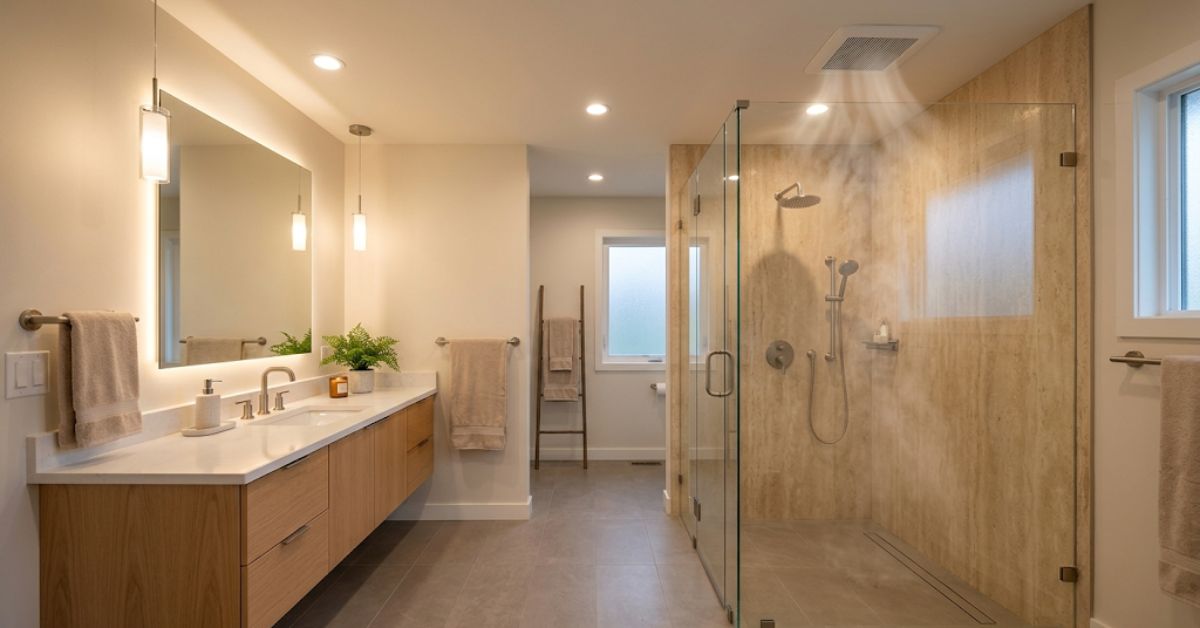
The correct placement is directly above the shower (with a damp-rated or wet-rated fan model), or as close to it as ceiling structure allows. This captures water vapor at its source before it can spread across the room. In larger master bathrooms, two smaller fans — one above the shower and one above the toilet or vanity area — outperform a single larger center-mounted fan, both in moisture removal and in noise level per fan.
For wet-room layouts where the entire floor is treated as a waterproofed surface, the same principle scales up. Fans should be positioned over the wettest zones — typically two fans in a large wet room, both damp-rated, with independent controls so the shower fan can run separately from the general-purpose fan.
Duct Routing — Where NC Homes Fail Most Often
A bathroom exhaust fan is only as effective as the duct that connects it to the outdoors. And this is where a substantial percentage of NC bathrooms fail — including many built in the last twenty years. Two failures are almost universally responsible:
Failure 1: Ducting Terminating in the Attic Rather Than the Exterior
A bathroom exhaust duct must terminate outside the building envelope — either through a roof cap or through a wall cap with backdraft damper. Terminating the duct in the attic — a shortcut common in tract construction — vents all that moisture directly into the attic space, where it condenses on the underside of the roof deck and creates ideal conditions for mold growth in the attic, insulation degradation, and eventually roof sheathing damage. If your existing bathroom fan discharges into an attic space (visible by looking at where the flex duct ends), that is the first thing to fix in any remodel.
Failure 2: Excessive Duct Length or Too Many Bends
Even properly terminated ductwork can strangle a fan’s actual output. Every bend and every foot of duct reduces effective CFM. A 100 CFM fan connected to 25 feet of flex duct with four 90-degree bends may only move 40 to 50 CFM of actual air. Correct installation uses rigid or semi-rigid duct wherever possible, minimizes bends, keeps total duct length as short as practical, and sizes duct diameter to the fan’s specifications (typically 4 inches for standard fans, 6 inches for higher-CFM fans).
Insulate Ducts in Unconditioned Spaces
Any duct running through an unconditioned attic must be insulated. Uninsulated ductwork in a cold attic causes the warm moist air inside to condense as it travels, dripping water back into the fan housing and eventually the bathroom ceiling — producing brown stains, sagging drywall, and eventual failure. Insulated flex duct or rigid duct wrapped in insulation solves this at trivial additional cost during installation.
Controls — Why the Switch Matters as Much as the Fan
A correctly sized and correctly ducted fan still fails at its job if the homeowner turns it off after their shower. The standard human behavior — flip the fan on at the start of the shower, flip it off when leaving the bathroom — provides only 8 to 12 minutes of exhaust time. Effective moisture removal requires the fan to continue running for 20 to 30 minutes after the shower ends. Depending on people to remember this is depending on failure.
Timer Switches
The simplest upgrade over a standard toggle switch. A timer switch lets the user press a 20-, 30-, or 60-minute option when leaving the bathroom, and the fan continues running unattended until the timer expires. Cost is minimal ($30 to $80 installed) and the behavior change is automatic.
Humidity-Sensing Switches
The best upgrade. A humidistat switch monitors bathroom humidity and automatically turns the fan on when humidity crosses a threshold (typically 60 to 65 percent), then automatically turns off when humidity returns to the setpoint. This works even when someone showers without touching a switch, works when houseguests do not know to run the fan, and works overnight when humidity spikes after showers taken during the day. Cost runs $80 to $180 installed. For any Piedmont-climate bathroom with a shower, this is the single highest-return ventilation upgrade.
Combined Timer + Humidistat
The premium option — automatic humidity activation with manual timer override. Homeowners can force the fan on during a shower (guaranteeing it activates before humidity climbs) and the humidistat keeps it running afterward until humidity is back to target. This is the specification we use as standard on Lake Norman luxury bathroom remodels and Davidson master bathroom projects.
Common Ventilation Mistakes That Guarantee Mold Problems
- Undersized fan. A 50 or 70 CFM fan in a 100-square-foot bathroom is undersized regardless of what the builder said. Size to actual bathroom square footage and usage pattern.
- Fan ducted into the attic. The single most common failure in NC construction. Every bathroom exhaust must terminate outside the building envelope.
- Long or convoluted duct runs. Every bend and every extra foot cuts effective CFM. Rigid duct, shortest practical run, minimum bends.
- Uninsulated duct in the attic. Warm moist air condenses in cold duct and drips back into the fan. Insulate every foot of duct running through unconditioned space.
- Standard toggle switch instead of timer or humidistat. Fan turns off when the last person leaves — long before humidity has been removed. Timer or humidistat is the fix.
- Fan centered in ceiling rather than positioned over the shower. Water vapor has to travel across the room to reach the fan intake, condensing on the ceiling along the way.
- No damper on exterior termination. Wind and pest intrusion pass freely into the duct. Backdraft dampers are standard code and low-cost.
- Reusing the existing fan during a remodel. If the existing bathroom had mold problems, upgrading everything except the ventilation guarantees the mold returns.
What Proper Ventilation Actually Costs
| Component | Cost Range (Materials + Install) |
|---|---|
| Quality 100–150 CFM fan (damp-rated) | $250–$550 |
| Premium ultra-quiet 150–200 CFM fan | $400–$900 |
| Insulated rigid duct + exterior termination cap | $200–$500 |
| Humidistat + timer combined switch | $80–$180 |
| Second fan for wet room or master (with controls) | $400–$800 |
| Complete Standard Bath Ventilation System | $600–$1,400 |
| Complete Master Bath / Wet Room System | $1,200–$2,600 |
On a Tier 2 or Tier 3 bathroom remodel running $18,000 to $34,000, proper ventilation represents 3 to 7 percent of total budget. That is a small allocation for what is objectively the single most consequential system in the bathroom — the difference between a remodel that stays beautiful for 20 years and one that develops mold problems within 3.
FAQ — Bathroom Ventilation
How do I know if my current bathroom fan is inadequate?
The clearest test is a tissue held to the fan grille during operation — if it sticks firmly to the grille, the fan is pulling adequate air. If it barely flutters or does not stick, the fan is undersized, the ducting is choked, or the fan itself has failed. Other signs: mirror stays fogged for more than 5 minutes after a shower, mildew returns on grout despite cleaning, ceiling paint bubbles above the shower, or moisture visibly beads on cool surfaces during and after showering.
Can I upgrade the fan without a full bathroom remodel?
Yes, in most cases. If the existing electrical rough-in is in place and the ducting is adequate, swapping a builder-grade 50 CFM fan for a properly sized 110 or 150 CFM fan and adding a humidistat is a same-day job — typically $400 to $900 total. If the existing ducting is poor or terminates in the attic, expect additional cost to correct the ducting. In many cases the ducting problem is what has been causing the mold issues, not the fan itself.
Do quieter fans move less air?
Not with modern fans. Premium ultra-quiet fans in the 1 to 2 sone range often move more air more efficiently than older builder-grade fans that operate at 3 to 5 sones. The old assumption that a noisy fan is a strong fan is outdated. Look at published CFM numbers, not perceived noise.
Is a window enough — do I still need a fan?
A window is not a substitute for exhaust ventilation. Windows depend on user behavior (opening them), on outdoor weather (unusable during rain or cold), and on cross-ventilation (which most bathrooms cannot generate). Building codes in most NC jurisdictions require an exhaust fan for windowless bathrooms; for bathrooms with windows, an exhaust fan is optional per code but strongly recommended for humidity management.
Where do I get ventilation reviewed as part of a remodel?
Every quality bathroom remodel should include a ventilation review as part of the initial scope. Carolina Creek Tub & Shower assesses existing ventilation on every consultation across Lake Norman stone shower installations, Huntersville master bathroom projects, Cornelius master bath work, and every other city in our NC service area — with fan sizing, duct routing, and humidistat controls specified upfront rather than left as an afterthought.
Related Master Bathroom Services Across NC
- Luxury Bathroom Remodeling Lake Norman — full master bathroom services including proper ventilation specification.
- Luxury Master Bathroom Remodeling Davidson, NC — Davidson master bathroom systems and design.
- Master Bathroom Remodeling Huntersville, NC — Huntersville master bathroom projects.
- Luxury Master Bath Remodeling Cornelius, NC — Cornelius master bath renovations.
- Master Bathroom Remodeling Matthews, NC — Matthews master bathroom design and installation.
- Premium Stone Shower Design Lake Norman — Lake Norman stone shower installations with proper wet-zone ventilation.
Get Ventilation Specified Right From the Start
Owner-led consultations, ventilation assessment as part of every remodel scope, properly sized fans with humidistat controls, insulated rigid ducting with exterior termination, and a lifetime warranty on every installation.