Get a Free Comfort Height Toilet Today
7 Bathroom Remodel Regrets – What Homeowners Say They’d Do Differently
7 Regrets
Repeated across every homeowner survey
$5K–$40K
Cost to fix these regrets after the fact
Zero
Extra cost to avoid them upfront
Lifetime
Warranty on every Carolina Creek install
Homeowner regret after a bathroom remodel follows a surprisingly predictable pattern. Reddit renovation threads, Houzz post-project surveys, NKBA designer feedback, and thousands of individual homeowner conversations all converge on essentially the same list — seven specific things that homeowners repeatedly say they wish they had done differently. The remarkable part is that avoiding every one of them costs almost nothing extra if the decisions are made upfront during design. Retrofitting them into a finished bathroom, on the other hand, costs $5,000 to $40,000 depending on which regret you are trying to fix.
This guide walks through the seven most-cited bathroom remodel regrets — with what the regret actually is, why homeowners keep making it, the daily consequences that produce the regret, what the “done right” alternative looks like, and roughly what it costs to fix after the fact versus getting it right during the initial remodel. Read this before your consultation, not after your walkthrough.
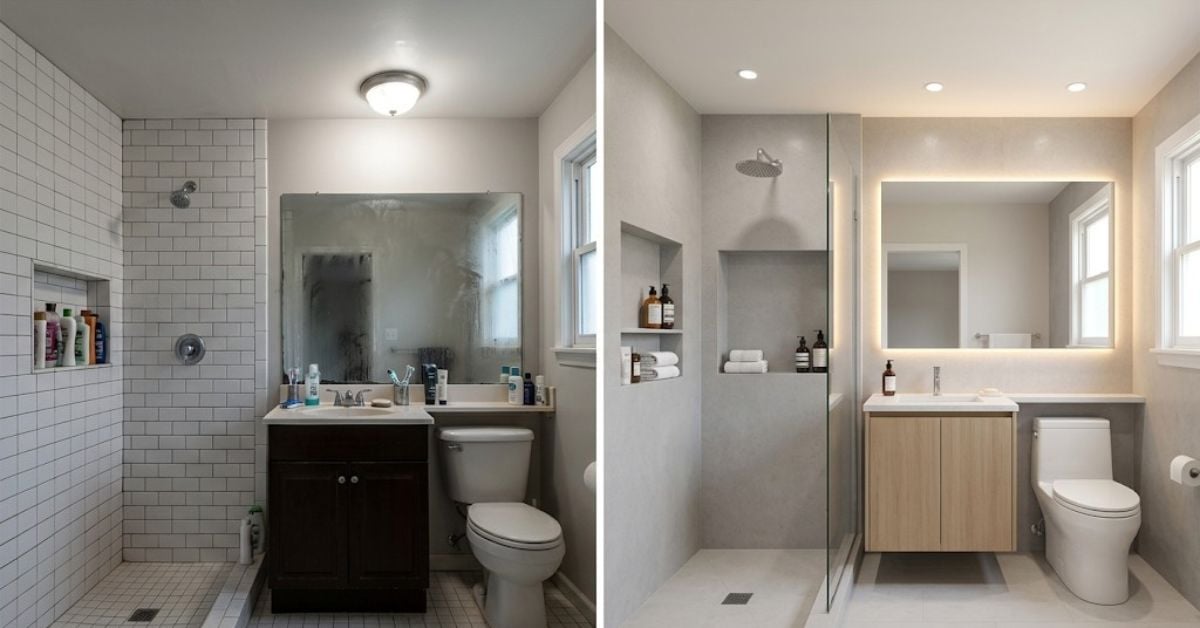
Regret 1: Skipping the Ventilation Upgrade
What homeowners say: “I have this beautiful new bathroom and mildew still shows up on the grout within six months.”
The single most-cited regret across every source. Homeowners upgrade every visible element of the bathroom — shower, vanity, tile, lighting, fixtures — and reuse the existing 50 CFM builder-grade exhaust fan installed in 1998. Within a year, the same mold and mildew problems that plagued the old bathroom start reappearing in the new one, on new grout, new caulk, and new paint. The ventilation was the source all along.
The fix during the remodel: $600 to $1,400 for a properly sized 110 to 150 CFM fan, insulated rigid duct terminating outside, and a humidistat control that runs the fan automatically when humidity crosses 65 percent.
The fix after the remodel: $1,800 to $4,500 to open the ceiling, replace the fan, correct the ducting (often ducted into the attic in NC construction), and add the humidistat. Plus repainting the ceiling and repairing any drywall damage caused by the moisture problems that started the whole discussion.
Regret 2: Keeping the Jetted Tub Because “We Might Use It”
What homeowners say: “We kept the jetted tub in the remodel and we have used it exactly twice in three years. It takes up half the bathroom and it is where towels get folded now.”
NKBA data shows the average American takes fewer than five baths per year. In a Piedmont climate where the water heater has to work hard to fill a large tub and where the tub sits cold most of the year, actual usage tends to be lower still. Homeowners keep the tub during a remodel because it feels wasteful to remove a functional fixture — then discover after two or three years that removing it would have transformed the daily use of the bathroom.
The fix during the remodel: Convert the tub footprint to a larger walk-in shower during the initial project. Typically saves $2,000 to $4,000 compared to keeping the tub (no jetted tub purchase, no plumbing work on jet lines, simpler waterproofing).
The fix after the remodel: $6,500 to $12,000 for a proper tub-to-shower conversion, done as a separate project years later — because the tub finally became too obviously wasteful to ignore.
Regret 3: Choosing Small-Tile Shower Walls Over Composite Stone Panels
What homeowners say: “I love how the tile looks. I hate what maintaining the grout does to my weekends.”
The 2026 NKBA Bath Trends Report shows 89 percent of homeowners now want fewer or no grout lines. That number is a lagging indicator — it reflects tens of thousands of homeowners who chose tile in previous remodels and now regret the maintenance burden. Small-tile grout lines require weekly scrubbing, quarterly deep cleaning, annual re-sealing, and regrouting every 5 to 10 years. In humid NC climate, the maintenance burden runs 25 to 40 hours per year.
The fix during the remodel: Choose composite stone panels ($5,000 to $10,000 installed) over small-tile shower walls. Non-porous surface, no sealing required, no grout to maintain, reads as premium natural stone. Our approach across Lake Norman stone shower installations and Davidson custom stone shower projects uses this material for exactly this reason.
The fix after the remodel: $7,000 to $12,000 to demolish existing tile, prepare the substrate, and install composite stone panels. Cost is close to a full shower re-build because the surrounding waterproofing and drain typically also need re-work.
Regret 4: Under-Sized or Poorly Placed Shower Niche
What homeowners say: “The niche only fits two bottles. Everything else lives on the shower floor. Or on a hanging caddy that rusts.”
Two common niche regrets: too small, or placed on the wrong wall. A 12×12 or 12×16 “accent niche” that some designers still specify holds a single small bottle and defeats its own purpose. A niche on the plumbing wall gets sprayed directly by the showerhead, meaning bottles fill with water and the niche interior stays wet. Both problems produce the same end state: a hanging shower caddy on top of the beautifully designed shower.
The fix during the remodel: Specify a 24×36 niche with an intermediate shelf placed on the wall opposite the showerhead at 55 to 60 inches from the shower floor. Adds $650 to $1,100 to a standard shower installation and eliminates the caddy problem permanently.
The fix after the remodel: Effectively impossible without demolishing the existing shower wall. Homeowners live with the caddy or invest $8,000 to $15,000 in a full shower re-build.
Regret 5: Insufficient Lighting — the Invisible Regret
What homeowners say: “The bathroom looks great in daylight photos. In real life I cannot see my face at the mirror without turning on my phone flashlight.”
The invisible regret. Bathroom lighting rarely gets discussed during initial scoping because it does not appear on Pinterest boards the way tile and fixtures do. Homeowners default to a single overhead fixture plus whatever wall sconces came with the previous vanity. In use, the overhead creates severe under-eye shadows for shaving and makeup, and the room feels dim and cave-like in evening hours.
The fix during the remodel: Design four independent lighting layers — task lighting at the vanity (LED backlit mirror or flanking sconces), ambient overhead, accent lighting in the shower and inside the niche, and decorative or nightlight for evening use. All on dimmer switches. Total system cost $1,500 to $4,000 as part of the initial remodel.
The fix after the remodel: $3,500 to $9,000 to open the ceiling and walls for wiring, add fixtures, install dimmer switches, and patch drywall. Three to five times the cost of doing it correctly upfront.
Regret 6: Standard-Height Toilet Instead of Comfort-Height
What homeowners say: “We noticed after a few months that the toilet was noticeably lower than what we were used to at hotels and friends’ homes. Now our knees feel it every day.”
Standard-height toilets sit at approximately 15 inches from floor to seat. Comfort-height toilets sit at 17 to 19 inches — the same height as a standard chair. The difference is small on paper but meaningful in daily use, especially for anyone over 55, anyone with knee or hip issues, and anyone tall enough that a standard-height toilet requires uncomfortable knee bend. Once homeowners get used to comfort-height in a hotel or a friend’s home, going back to standard-height feels like a step backward.
The fix during the remodel: Specify comfort-height toilet during initial scope. Cost difference is negligible — often less than $100 more than a standard-height model.
The fix after the remodel: $450 to $900 for a toilet swap done as a standalone project — including new supply line, new wax ring, disposal of old toilet, and installation labor. Not expensive, but rarely happens because homeowners live with the smaller inconvenience rather than call a plumber for a fix they should have specified upfront.
Regret 7: Chose the Cheapest Vanity to Save Budget for Elsewhere
What homeowners say: “The MDF vanity swelled at the base within four years. The finish is peeling. I saved $1,500 upfront and now I need to replace it for $3,000.”
Builder-grade MDF and particleboard vanities are the false economy of bathroom remodels. They look almost identical to solid-wood vanities in the showroom and in initial installation photos — but they cannot handle sustained humid environment. Within 4 to 8 years, moisture wicks into the substrate, the base swells, the finish peels at the toe kick, and the whole vanity looks tired. The saving is real ($800 to $2,000 upfront) but the durability difference eventually produces a second remodel.
The fix during the remodel: Specify solid-wood vanity construction with quartz countertop. Adds $1,900 to $3,400 over builder-grade MDF but comes with 10 to 25 year manufacturer warranties and lasts the life of the bathroom.
The fix after the remodel: $2,800 to $5,200 to remove the failed vanity, install the solid-wood replacement, reconnect plumbing, and patch any wall damage. Plus disposal of the earlier vanity that had another decade of theoretical life if it had been built to last.
The Complete Regret List — Cost During Remodel vs Cost After
| Regret | Fix During Remodel | Fix After the Fact |
|---|---|---|
| 1. Skipping ventilation upgrade | $600–$1,400 | $1,800–$4,500 |
| 2. Keeping the unused jetted tub | Save $2K–$4K | $6,500–$12,000 |
| 3. Small tile over composite stone | Modest premium at spec | $7,000–$12,000 |
| 4. Undersized shower niche | $650–$1,100 | $8,000–$15,000 |
| 5. Insufficient lighting layers | $1,500–$4,000 | $3,500–$9,000 |
| 6. Standard-height toilet | Less than $100 | $450–$900 |
| 7. Cheap MDF vanity | $1,900–$3,400 | $2,800–$5,200 |
| Total If All Fixed Upfront | $4,650–$9,900 | $30,050–$58,600 |
The compound principle: Every regret on this list is invisible during initial design and immediately visible in daily use. The pattern is not about being smarter than other homeowners — it is about knowing which decisions become permanent the moment the drywall closes. Consultation with a contractor who raises these questions upfront saves 3 to 6 times what it costs to fix any single regret later.
FAQ — Bathroom Remodel Regrets
If I can only avoid one regret, which one matters most?
Ventilation. It is the least visible upgrade but the one whose absence produces daily consequences and eventually threatens the durability of everything else in the bathroom. If your contractor is not raising ventilation upgrades in the initial scope discussion, that is a signal to raise it yourself — or to consult a different contractor.
Why do contractors not raise these regrets during consultation?
Some do. Many do not, because raising them upfront extends the scope discussion, adds cost that competes with the shower and vanity spend, and requires the contractor to acknowledge that the “easy” version of the remodel will produce regret. A quality contractor treats regret prevention as part of their job. A price-competition-focused contractor treats it as friction that costs them the sale. The difference is often visible within the first 15 minutes of a consultation.
Are there regrets specific to NC bathrooms?
Ventilation regret is meaningfully worse in NC than in drier climates because Piedmont humidity accelerates the mold and mildew problems that undersized ventilation produces. Grout regret is also worse because humidity affects grout durability. Both of the top two regrets on this list are worse in NC than they would be in Arizona or Colorado — which means NC homeowners should treat both as first-priority decisions rather than afterthoughts.
Do these regrets affect resale value?
Yes. Buyers today are meaningfully more sophisticated than a decade ago about bathroom quality signals. Visible tile grout in poor condition, small niches, cave-like lighting, and standard-height toilets all read as “budget remodel” to educated buyers. The regrets that produce daily inconvenience for homeowners produce reduced offers from buyers.
Where do I get a consultation that raises these decisions upfront?
Every quality consultation should walk through these decisions before moving to material selection. Carolina Creek Tub & Shower includes regret-prevention as part of the initial scope discussion across Lake Norman luxury bathroom remodels, Davidson master bath work, Huntersville master bathroom projects, and every other city in our NC service area — with owner-led consultations, honest scope discussions, and itemized quotes that make trade-offs visible before commitment.
Related Master Bathroom Services Across NC
- Luxury Bathroom Remodeling Lake Norman — full master bathroom services with regret-prevention scope discussions.
- Luxury Master Bathroom Remodeling Davidson, NC — Davidson master bathroom projects.
- Luxury Master Bath Remodeling Cornelius, NC — Cornelius master bath renovations.
- Master Bathroom Remodeling Huntersville, NC — Huntersville master bathroom services.
- Premium Stone Shower Design Lake Norman — composite stone shower installations.
- Master Bathroom Remodeling Matthews, NC — Matthews master bathroom design.
Get a Consultation That Prevents the Regrets Before They Happen
Owner-led consultations, honest scope discussions covering ventilation, lighting, materials, and hardware decisions upfront, itemized written quotes making every trade-off visible, and a lifetime warranty on every installation.